
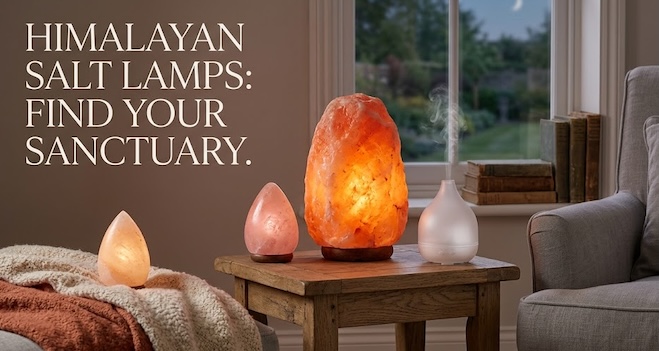
Benefits, Uses, and What They Actually Do
If you have ever walked into a spa, a yoga studio, or a thoughtfully curated holistic living space, you have likely noticed the warm, amber glow of a Himalayan salt lamp. These beautiful objects are more than just decorative pieces. At Still Alchemy, we believe in blending science-informed knowledge with mindful living. That is why we want to provide you with the most factual, clear, and useful information on Himalayan salt lamps: what they are, what they actually do, what they do not do, and how to use them meaningfully in your home.
What Is a Himalayan Salt Lamp?
A Himalayan salt lamp is a solid chunk of salt crystal, typically mined from the Punjab region of Pakistan, near the Himalayan foothills. Despite the name, most lamps do not come from India or Nepal. The salt is hand-mined from ancient sea beds that formed over 250 million years ago. These crystals range in color from pale orange to deep reddish-pink, thanks to trace minerals like iron, magnesium, and potassium.
Each lamp is hollowed out to fit a small incandescent or LED bulb. When the bulb heats the salt, the crystal emits a soft, diffused amber light. The heat also increases the release of negative ions, which is where most of the health claims originate. However, as we will explore, the science behind those claims requires careful examination.
Himalayan Salt Lamp
This large 10–12 inch Himalayan salt lamp is designed for bedroom or office use. It features a genuine pink salt crystal on a wooden base, includes a dimmer for adjustable amber glow, and comes with spare bulbs. The lamp promotes calming ambient light, supports evening relaxation and mindfulness routines, and is positioned as a thoughtful wellness gift. Consistent with Still Alchemy’s approach, its real value lies in creating a warm, low-light atmosphere—not in unproven health claims. Safe, practical, and aesthetically grounding.

The Purported Benefits of Himalayan Salt Lamps
Across the internet and wellness communities, you will find many claims about Himalayan salt lamps. Below, we separate commonly reported benefits from what science actually supports.
1. Air Purification (The Negative Ion Theory)
The most widespread claim is that salt lamps act as natural air purifiers by producing negative ions. Negative ions are molecules that have gained an electron. They are found in nature near waterfalls, beaches, and after thunderstorms. Positive ions, by contrast, are emitted by electronics, air conditioners, and synthetic materials.
What the science says:
Laboratory studies have shown that negative ion generators can reduce airborne dust, bacteria, and allergens. However, a Himalayan salt lamp produces a very small number of negative ions. Research indicates that a single salt lamp heated by a 15-40 watt bulb produces fewer negative ions than most natural environments. One study found that the effect of a salt lamp on particulate matter in a standard-sized room is negligible compared to a dedicated HEPA air filter. In short, while the theory is appealing, a salt lamp alone should not be relied upon for medical-grade air purification.
2. Mood Enhancement and Relaxation
This is where Himalayan salt lamps shine—literally. The warm, low-intensity amber light creates a calming ambiance. Unlike blue-rich white light from screens and LEDs, the orange-pink glow does not suppress melatonin production as strongly.
What the science says:
Lighting color temperature affects circadian rhythms. Warm light (around 1900-2200K) promotes relaxation. While no large-scale clinical trial specifically proves salt lamps treat anxiety or depression, the principles of chromotherapy and environmental psychology support that soft, warm lighting reduces stress. Many users report feeling calmer in a room lit by a salt lamp. From a practical standpoint, if a lamp helps you unwind before bed, it is beneficial for your mental health.
3. Reducing Electromagnetic Radiation (EMF)
Some wellness sources claim that salt lamps neutralize or absorb electromagnetic fields (EMF) from computers, phones, and Wi-Fi routers.
What the science says:
This claim has no scientific basis. Salt crystals do not absorb or block electromagnetic radiation. The lamp itself runs on electricity and produces its own low-level EMF. A Himalayan salt lamp does not protect you from EMF. However, the soft light may encourage you to turn off other electronic devices, indirectly reducing your overall EMF exposure.
4. Respiratory Relief for Allergies and Asthma
Small-scale, anecdotal reports suggest that sitting near a heated salt lamp helps with breathing. This is loosely tied to halotherapy (dry salt therapy), where people sit in salt-lined rooms.
What the science says:
Halotherapy uses pharmaceutical-grade salt aerosol generators in controlled clinical settings. A passive salt lamp does not emit enough salt particles into the air to affect lung function. The heat from the bulb is insufficient to aerosolize salt crystals in a meaningful way. Therefore, Himalayan salt lamps are not a treatment for asthma, COPD, or allergies.
Practical Uses for Himalayan Salt Lamps
Even without the exaggerated health claims, salt lamps have many legitimate and valuable uses in a holistic home.
- Ambient lighting for meditation and yoga: The soft glow reduces visual clutter and promotes a meditative state.
- Nightlight: Unlike blue-spectrum nightlights, the amber light is less disruptive to sleep hormones.
- Decorative accent: Pink salt complements natural wood, plants, stone, and earth tones.
- Mindful focal point: Placing a lamp in your workspace can serve as a visual reminder to breathe and pause.
- Low-level mood lighting for evening routines: Use it while reading, journaling, or stretching.
Safety Considerations and Maintenance
Himalayan salt lamps are hygroscopic, meaning they attract moisture from the air. If you live in a humid climate, your lamp may “sweat” or weep. This is normal but requires care.
- Always keep the lamp on a waterproof, non-porous surface to prevent water damage to wood or fabric.
- Do not leave the lamp on for days at a time unattended – the heat and moisture combination can create a shock hazard if the cord or socket gets wet.
- Clean with a slightly damp cloth only when unplugged and cool. Never submerge in water.
- Replace the bulb as recommended. Use low-wattage bulbs (15-25 watts) to avoid overheating the salt.
- Keep out of reach of pets. Excessive licking of salt can lead to sodium ion poisoning in small animals.
How to Choose an Authentic Himalayan Salt Lamp
Not all pink salt lamps are authentic. Some are made from lower-quality salt or even plastic resin. At Still Alchemy, we recommend:
- Looking for natural variations in color and texture. Real salt lamps are not uniform.
- Checking the weight. A genuine 5-7 kg lamp feels heavy for its size.
- Avoiding perfectly smooth, brightly dyed lamps.
- Buying from reputable sources that disclose the origin (Pakistan, Khewra Salt Mine region).
What Himalayan Salt Lamps Actually Do (Summary)
| Claim | What Actually Happens |
|---|---|
| Purifies air | Minimal to no measurable effect |
| Improves mood | Yes, via warm light and ambiance |
| Reduces EMF | No scientific evidence |
| Treats asthma | No, not a medical device |
| Creates relaxation | Yes, when used intentionally |
| Produces negative ions | Very small amounts, negligible |
Still Alchemy and the Mindful Use of Salt Lamps
At Still Alchemy, we do not promote false hope or pseudoscience. Instead, we honor the intersection of ancient wisdom and modern clarity. A Himalayan salt lamp will not cure your allergies or shield you from technology. But it can transform a corner of your home into a sanctuary. It can remind you to slow down. It can replace harsh artificial light with something softer, warmer, and more human.
We believe that true alchemy is turning ordinary moments into mindful ones. A salt lamp does not need to perform miracles to be valuable. Its real benefit is not in the air, but in the atmosphere it creates. When you sit in the glow of a salt lamp, you are not waiting for science to prove a cure. You are practicing presence. That, to us, is the most honest benefit of all.
We curate our recommendations based on safety, authenticity, and real-world usefulness. If you choose to bring a Himalayan salt lamp into your space, do so with clear eyes: enjoy the beauty, embrace the calm, and let the rest go.
Himalayan salt lamps are safe, beautiful, and relaxing when used correctly. They do not replace medical devices, air purifiers, or EMF shields. They do provide a warm, low-light environment that supports evening wind-down, meditation, and visual comfort. Use them intentionally, keep them dry, and let their glow be enough.
You must be logged in to post a comment.