
For Stress, Anxiety, and Clarity
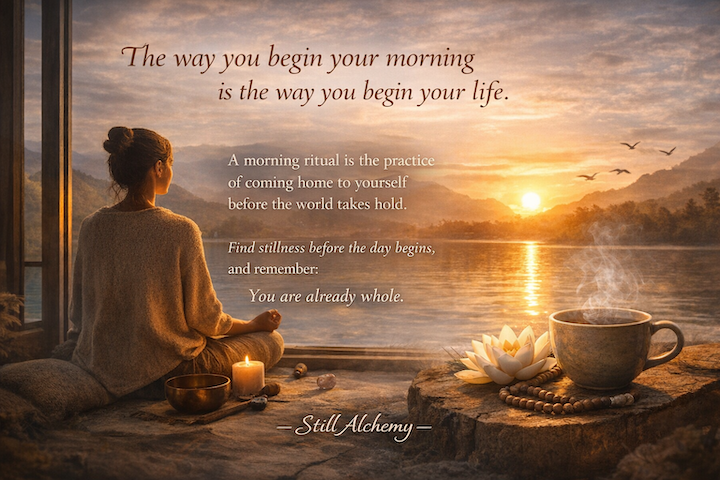
The way you begin your morning is the way you begin your life. Not in a dramatic, all-or-nothing sense, but in the quiet, cumulative way that days stack into weeks, weeks into months, and months into the person you are becoming. A morning ritual is not a productivity hack. It is not a checklist to optimize your output or add more structure to an already over-scheduled life. It is something far more essential: it is the practice of returning to yourself before the world gets its hands on you.
At Still Alchemy, we believe that beneath all of life’s noise, you are already whole. A calming morning ritual is simply the practice of remembering that — day after day, breath after breath.
This guide is for those who wake up already tense, already behind, already anxious before the day has even started. It is for those who want more than productivity — who want presence, peace, and the kind of clarity that comes not from doing more, but from slowing down enough to hear themselves think.
What Is a Morning Ritual, and Why Does It Matter?
A morning ritual is a sequence of intentional practices done consistently at the start of your day to support your physical, mental, emotional, and spiritual wellbeing. Unlike a morning routine, which is largely logistical — shower, coffee, commute — a morning ritual is purposeful. Every element is chosen because it nourishes you.
The science behind morning rituals is substantial. Cortisol, the body’s primary stress hormone, naturally peaks within 30 to 45 minutes of waking in what researchers call the Cortisol Awakening Response (CAR). How you spend that window directly influences your stress levels, mood, and cognitive function for the rest of the day. Studies published in journals like Psychoneuroendocrinology have shown that engaging in mindfulness and slow, deliberate activity during this window can blunt cortisol spikes and reduce baseline anxiety over time.
Beyond cortisol, morning rituals work because they create what neuroscientists call behavioral activation — small, successful actions that prime the brain’s reward circuitry and build positive momentum. They also reduce decision fatigue. When the first hour of your day is structured around practices that feel good, your nervous system learns to associate mornings with safety and calm rather than stress and urgency.
For those managing chronic stress, anxiety disorders, or burnout, this matters enormously. The nervous system is trainable. And the morning is the most fertile training ground you have.
The Foundation: Before You Pick Up Your Phone
The single most impactful thing you can do for your mental health in the morning costs nothing and requires nothing: do not look at your phone for the first 30 minutes after waking.
This is not hyperbole. Checking your phone immediately upon waking floods the brain with information, comparison, urgency, and stimulation at the exact moment it is most neurologically vulnerable. The prefrontal cortex — the part of the brain responsible for calm, rational decision-making — takes time to fully activate after sleep. Hitting it with social media, news, or email before it has warmed up is the neurological equivalent of running a sprint before stretching.
Instead, let the first moments of your day belong entirely to you. Keep your phone across the room if needed. Use an analog alarm clock. Create physical distance between yourself and the digital world so that your morning ritual can actually take root.
This simple boundary is the foundation on which every other practice rests.
Step One: Begin with the Breath
Before you get out of bed, before you think about what has to happen today, return to the breath. The breath is the only function of the autonomic nervous system that you can consciously control, and it is your most direct line to calm.
A foundational breathing practice for anxiety and stress is diaphragmatic breathing, also known as belly breathing. Place one hand on your chest and one on your belly. Inhale slowly through your nose for a count of four, allowing your belly to rise while your chest stays relatively still. Hold for a count of two. Exhale through your mouth for a count of six or eight. The extended exhale is key — it activates the parasympathetic nervous system, the body’s rest and digest mode, and begins to lower both heart rate and cortisol levels.
A more advanced technique used widely in clinical and contemplative settings is box breathing, also known as four-square breathing. Inhale for four counts, hold for four, exhale for four, hold for four. Navy SEALs use this technique to manage acute stress under pressure. Therapists recommend it for anxiety and panic. Ancient yogic traditions knew it long before either of those groups.
Even five minutes of intentional breathwork each morning is enough to begin changing your baseline nervous system tone over time. At Still Alchemy, breathwork is woven into everything we do — from sound bath sessions to yoga — because we know that the breath is not just a function. It is a homecoming.
Step Two: Hydrate Before You Caffeinate
Your body has spent six to nine hours without water. Before you do anything else — before coffee, before food, before a single task — drink a full glass of water. Dehydration, even mild dehydration of one to two percent of body weight, has been shown in research from the Journal of Nutrition to impair mood, concentration, and increase the perception of task difficulty and fatigue.
For an extra layer of benefit, add a squeeze of fresh lemon. Lemon water supports liver detoxification processes that are active overnight, provides a small amount of vitamin C, and — more subtly — the ritual of preparing and drinking it slowly can itself become a mindful act.
Hold off on caffeine for at least 60 to 90 minutes after waking. This is not about avoiding coffee — it is about timing. Cortisol is naturally high in the first hour after waking. Consuming caffeine during this window builds tolerance to caffeine over time and reduces its effectiveness. Waiting until cortisol has naturally begun to drop means the caffeine works better and is less likely to contribute to that mid-morning crash. This is a well-established principle among sleep scientists and is increasingly backed by research from institutions like the Uniformed Services University of the Health Sciences.
Step Three: Move Your Body — Gently
Morning movement is not about burning calories or hitting macros. It is about waking the body up kindly, releasing the physical tension that sleep sometimes fails to fully clear, and generating the neurochemical environment your day needs to flourish.
You do not need an intense workout. In fact, for those dealing with anxiety and chronic stress, intense morning exercise can sometimes backfire — elevating cortisol rather than calming it, particularly if the body is still in a depleted state. What the research supports for morning anxiety relief is gentle, parasympathetic-friendly movement.
Yoga is one of the most studied and effective forms of morning movement for stress and anxiety. A 2018 meta-analysis published in the Journal of Evidence-Based Integrative Medicine found that yoga practice significantly reduces anxiety and perceived stress across diverse populations. Specific poses — child’s pose, cat-cow, seated forward folds, legs up the wall — activate the vagus nerve and promote a state of physiological calm. At Still Alchemy, our yoga offerings are rooted in this understanding: movement as medicine, breath as the guide.
A simple five to fifteen minute practice of gentle stretching or yoga nidra-inspired movement is enough to shift your physiology and signal to your nervous system that this day begins from a place of ease.
If yoga is not your path, a slow walk in natural light works beautifully. Natural light exposure in the morning sets your circadian rhythm, regulates melatonin and serotonin production, and has been shown in research to reduce symptoms of depression and anxiety. Even ten minutes outdoors — barefoot on grass if possible, a practice known as grounding or earthing — can measurably change your biomarkers of stress.
Step Four: Stillness and Meditation
Stillness is the central practice of Still Alchemy, and it is central to any truly calming morning ritual. Meditation is not about emptying the mind — a misconception that keeps many people from ever starting. It is about observing the mind without being controlled by it. It is the practice of sitting with what is, without needing it to be different.
Even five minutes of seated meditation in the morning creates measurable changes in anxiety, cortisol levels, and emotional regulation. Research from Harvard Medical School has demonstrated that regular mindfulness meditation reduces the size and reactivity of the amygdala — the brain’s alarm system — while thickening the prefrontal cortex, which governs calm reasoning and emotional regulation.
For beginners, a simple body scan is the most accessible entry point. Sit comfortably, close your eyes, and slowly bring your attention from the top of your head to the tips of your toes, noticing sensation without judgment. This grounds you in the body, out of the anxious mind, and reestablishes the mind-body connection that stress and modern living tend to sever.
For those who want to go deeper, mantra meditation — the silent repetition of a sound or word — has roots in both Vedic tradition and modern clinical research. Studies have shown it to be particularly effective for reducing anxiety and blood pressure. Loving-kindness meditation (Metta), which involves the deliberate cultivation of compassion for yourself and others, has been shown to reduce symptoms of PTSD, social anxiety, and depression.
Sound is another potent portal into stillness. This is something Still Alchemy holds at the heart of its work. Crystal singing bowls, Tibetan bowls, and gong baths create sound frequencies that guide the brain from beta waves — active, alert, anxious — into alpha and theta states of deep rest and restoration. Listening to recordings of a sound bath — or joining one in person — as part of your morning meditation practice can accelerate the transition into stillness and profoundly reduce morning anxiety.
Step Five: Journaling for Clarity
The morning mind is uniquely unfiltered. Before the day’s demands layer over your thoughts, there is a window of access to your deeper knowing — fears, intentions, dreams, desires — that is unlike any other time of day. Journaling in the morning is how you mine that window for gold.
Morning Pages, popularized by Julia Cameron in The Artist’s Way, involves writing three pages of stream-of-consciousness thought immediately upon waking — not for literary quality, but as a form of mental clearing. Think of it as draining the overnight accumulation of mental noise so that what remains is cleaner, quieter, and truer.
Gratitude journaling is among the most researched wellbeing practices in positive psychology. Studies from UC Davis by researcher Robert Emmons have consistently found that people who write about gratitude regularly report higher levels of positive emotion, less depression, lower anxiety, and better sleep. Even writing three specific things you are grateful for each morning — not generic, but specific and felt — begins to rewire the brain’s negativity bias over time.
Intention setting is a third dimension of morning journaling. Rather than writing a to-do list, ask yourself: How do I want to feel today? What matters most to me today? What is one thing I can offer to the world today? These questions orient your day toward meaning rather than urgency, which is a radical act in a world that constantly mistakes busyness for purpose.
Step Six: Nourishment That Supports Your Nervous System
What you eat in the morning directly affects your stress response and anxiety levels throughout the day. The gut and the brain are in constant communication via the gut-brain axis, and blood sugar fluctuations are one of the most underappreciated drivers of anxiety, irritability, and mental fog.
A morning meal that supports calm and clarity is one that stabilizes blood sugar: adequate protein, healthy fats, and fiber-rich carbohydrates. Eggs, avocado, nuts, seeds, oats with nut butter, Greek yogurt with berries — these foods provide slow-release energy that prevents the cortisol spikes associated with blood sugar crashes.
Magnesium deserves special mention. Magnesium is involved in over 300 enzymatic reactions in the body and plays a critical role in regulating the stress response. Research published in Nutrients found that magnesium deficiency — which is widespread in modern populations — is strongly correlated with elevated anxiety. Foods rich in magnesium include dark leafy greens, pumpkin seeds, almonds, dark chocolate, and bananas.
Adaptogenic herbs are another layer worth exploring. Ashwagandha, rhodiola, and holy basil (tulsi) have centuries of use in Ayurvedic and traditional medicine for managing stress and supporting adrenal health. Modern research increasingly validates these uses. A morning tea made with tulsi or ashwagandha can be a beautiful, ritual addition to a calming morning practice.
Step Seven: Set the Sonic Environment
Sound shapes mood and physiology in ways that are only beginning to be fully understood by Western science but have been known by ancient healing traditions for millennia. The sounds you surround yourself with in the morning matter.
Avoid starting your morning with the news, high-energy podcasts, or aggressive music. These elevate sympathetic nervous system activation and set a tone of urgency and alertness that may be counterproductive to calm.
Instead, create a morning soundscape that supports your intention. Nature sounds — rain, birdsong, running water — have been shown in multiple studies to reduce stress hormones and improve mood. Binaural beats in the alpha range (8 to 12 Hz) support relaxed focus and have been used clinically to reduce anxiety. Classical music at 60 beats per minute slows heart rate and supports cognitive clarity.
Sound healing frequencies, such as 432 Hz and 528 Hz, are a growing area of interest in integrative wellness and are at the heart of Still Alchemy’s work. These frequencies are said to resonate with the body’s natural harmonic structure. Whether or not the full science has caught up with the tradition, the experiential reality is consistent: people feel better, calmer, and more whole in the presence of healing sound. Our sound bath sessions at Still Alchemy exist precisely to offer this — a full sonic reset that no amount of solo self-care can replicate.
How Still Alchemy Supports Your Morning Practice
Still Alchemy was born from one belief: beneath life’s noise, you are already whole. Everything we offer — sound baths, yoga, art and creative healing, guided meditation, and our wellness retreats — is an extension of that belief in practice.
We understand that a morning ritual built entirely alone can feel hard to sustain. Habits form more easily in community, with guidance, and in environments specifically designed to support transformation. Our sound bath experiences offer a weekly or regular reset that deepens the effects of your daily practice. Our yoga sessions ground you in body and breath. Our art and creative healing sessions unlock emotional clarity that journaling alone sometimes cannot reach.
When you come to Still Alchemy, you are not just attending a class. You are entering a sanctuary — a space intentionally held for the kind of stillness and reconnection that modern life rarely makes room for. Our practitioners are devoted to the ancient wisdom that healing is not something done to you, but something that arises through you when the conditions are right.
Your morning ritual creates those conditions at home, every day. Still Alchemy deepens them when you are ready to go further.
A Practical Morning Ritual Template
Here is a simple, flexible template you can begin tomorrow. Adjust the timing and sequence to suit your life. The goal is not perfection — it is consistency and gentleness.
Upon waking: Do not look at your phone. Take three deep, slow breaths before your feet hit the floor.
Minutes 1–5: Drink a glass of water. Take it slowly. Let this be your first deliberate act of self-care.
Minutes 5–15: Gentle movement — five to ten minutes of yoga, stretching, or a slow walk. Let your body wake up before your mind takes over.
Minutes 15–25: Breathwork and meditation. Five minutes of box breathing followed by a five-minute body scan or mantra meditation.
Minutes 25–35: Journaling. Three gratitudes, one intention, and anything else that surfaces. Let it be messy and honest.
Minutes 35–45: Nourishing breakfast. No phone, no screens. Eat slowly. Taste your food.
Minutes 45 onwards: Now you may engage with the world — with a nervous system that is regulated, a mind that is present, and a heart that is open.
The Deeper Truth About Morning Rituals
A calming morning ritual is not about becoming a better, more optimized version of yourself. It is about returning, again and again, to the self that was always there beneath the anxiety, the urgency, and the noise.
The ancient alchemists believed that transformation did not come from adding something foreign to a substance — it came from purifying what was already present, removing the dross to reveal the gold that had always been there. This is the alchemy of a morning ritual. You are not building yourself up from nothing. You are clearing away what is not you — the cortisol, the distraction, the fear — so that what remains is clear, still, and whole.
Still Alchemy — where transformation begins in the quiet.
You must be logged in to post a comment.