
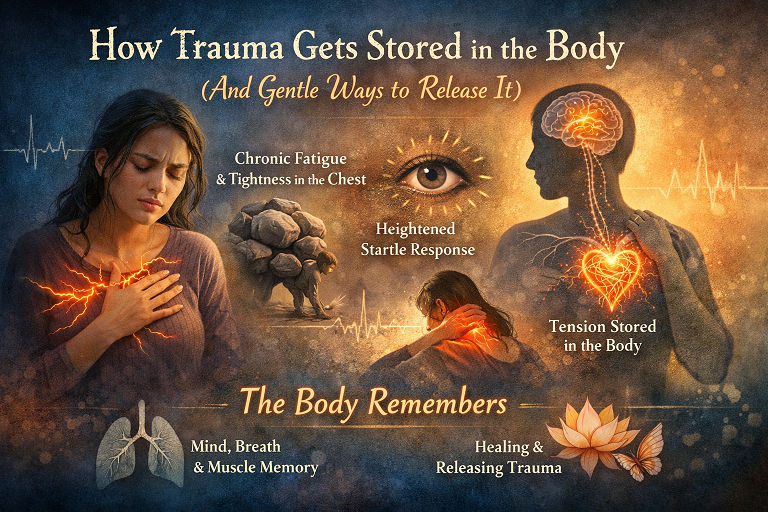
And Gentle Ways to Release It
There is a particular kind of exhaustion that sleep cannot touch. A tightness in the chest that arrives without warning. A startle response that fires too quickly, too loudly, long after the danger has passed. If any of this feels familiar, you are not imagining it — and you are not broken. What you are experiencing may be the body’s memory: trauma stored not just in the mind, but in the tissue, the breath, the very architecture of how you move through the world.
Table Of Contents:
At Still Alchemy, we believe the body is not a passive vessel for the mind’s experiences. It is an intelligent, living record. And understanding how that record gets written — and how it can be gently rewritten — is one of the most important acts of self-knowing you can undertake.
What Trauma Actually Is
Before we can understand where trauma lives, we need to release the idea that trauma must be catastrophic to count. Yes, trauma includes what we commonly recognize: violence, accidents, loss, abuse, war. But it also includes the slow accumulation of emotional neglect, chronic stress, medical procedures, relational rupture, and any experience that overwhelmed the nervous system’s capacity to process and integrate.
The word trauma comes from the Greek for “wound.” And like a physical wound, psychological and physiological trauma follows a predictable pattern when left unprocessed: it closes over on the surface, but beneath that surface, the tissue remains tender and reactive.
What determines whether an experience becomes traumatic is not the size of the event itself, but whether the nervous system was able to complete its response. A zebra chased by a lion, once safe, will literally shake and tremble to discharge the survival energy. Humans, uniquely, often suppress this discharge — out of social expectation, the need to keep functioning, or simply because no one taught us otherwise. That suppressed energy does not disappear. It goes somewhere.
The Science of Somatic Memory
The body keeps a score — a phrase made famous by psychiatrist Bessel van der Kolk, whose decades of research transformed how we understand trauma. His work, alongside that of Peter Levine, Stephen Porges, and others, gave us the neurobiological framework to understand what earlier healers and contemplative traditions had long intuited: the body remembers.
Here is what happens physiologically when trauma occurs:
When we perceive a threat, the amygdala — the brain’s alarm center — triggers the hypothalamic-pituitary-adrenal (HPA) axis, flooding the body with cortisol and adrenaline. The prefrontal cortex, responsible for rational thought and language, partially goes offline. We are no longer thinking our way through an experience; we are surviving it.
In the process, the hippocampus — which normally helps sequence memories in time — becomes impaired. This is why traumatic memories often feel fragmented, non-linear, or as though they are happening now rather than in the past. The nervous system did not file the memory neatly. It encoded it somatically: in the body’s posture, muscle tension, breath patterns, and autonomic arousal.
Research using neuroimaging has shown that when trauma survivors recall their experiences, the language centers of the brain go quiet while the sensory and emotional areas light up with the same intensity as the original event. The body, in a very real sense, cannot distinguish between remembering and reliving.
Polyvagal Theory and the Nervous System Hierarchy
Stephen Porges’ Polyvagal Theory offers one of the most elegant and useful maps of how the nervous system responds to threat — and why trauma can leave us stuck.
The vagus nerve, the longest cranial nerve in the body, governs our social engagement system, our capacity for calm, and our ability to connect with others. According to Polyvagal Theory, the nervous system moves through a hierarchy of states:
Safe and social (ventral vagal): We feel connected, curious, open. The face is expressive, voice is warm, hearing is attuned to human speech.
Fight or flight (sympathetic activation): Threat is perceived. The body mobilizes for action. Heart rate and breathing increase. Muscles prepare to fight or run.
Freeze or collapse (dorsal vagal): When fight or flight is not possible, the nervous system defaults to shutdown. The body goes still, numb, dissociated. This is the ancient survival strategy of “playing dead.”
Trauma, particularly repeated or early-life trauma, can leave the nervous system chronically cycling between these lower states — hypervigilant and mobilized, or shut down and dissociated — with limited access to the ventral vagal state of safety and connection. The body is not misbehaving. It is doing exactly what it learned to do to survive.
Where the Body Holds It
Different trauma patterns tend to localize in specific regions:
The jaw and neck: Chronic tension here often correlates with suppressed speech — words never said, cries held in. The body of someone who learned early that expressing emotion was unsafe frequently carries years of unexpressed feeling in the masseter muscles and throat.
The shoulders and upper back: The protective hunch, the bracing for impact, the weight of hypervigilance carried across the upper body. Many people who grew up in unpredictable environments carry their shoulders near their ears as a habitual posture, even in safety.
The diaphragm and chest: The breath is one of the first things to change under threat — it becomes shallow and high, bypassing the belly. For some, this shallow breathing becomes so habituated that they have forgotten what a full breath even feels like. The chest tightens around unexpressed grief and fear.
The hips and pelvis: This region holds some of the deepest and oldest patterning. The hip flexors, particularly the psoas muscle — which connects the lumbar spine to the femur and is sometimes called the “muscle of the soul” — contract under threat in preparation for running or curling into a protective position. Unresolved stress and trauma can leave the psoas chronically shortened, contributing to lower back pain, digestive issues, and a general sense of being unable to feel grounded.
The gut: The enteric nervous system — the network of neurons lining the gastrointestinal tract — contains approximately 100 million nerve cells, more than either the spinal cord or the peripheral nervous system. This “second brain” communicates bidirectionally with the central nervous system and is exquisitely sensitive to emotional and stress states. Unresolved trauma frequently manifests as chronic digestive issues, including IBS, nausea, and inflammation.
How Stored Trauma Shows Up
Unprocessed trauma does not stay quiet. It speaks through the body in many languages:
Physical symptoms: Chronic pain with no clear medical cause, fatigue, autoimmune conditions, frequent illness, tension headaches, digestive disorders, disrupted sleep, heightened pain sensitivity.
Emotional patterns: Disproportionate emotional reactions (especially to seemingly minor triggers), emotional numbness or flatness, difficulty feeling joy, sudden floods of feeling that seem to come from nowhere.
Cognitive patterns: Difficulty concentrating, intrusive thoughts or images, hypervigilance, difficulty distinguishing past threat from present safety, a pervasive sense of dread.
Relational patterns: Difficulty with trust, oscillating between clinging and withdrawal, difficulty setting limits, attraction to familiar (even if harmful) dynamics, an inability to fully receive love or care.
Somatic dissociation: Feeling disconnected from the body, difficulty feeling physical sensations, a sense of watching yourself from outside (depersonalization), or a feeling that the world is unreal (derealization).
It is worth noting that these patterns are not character flaws. They are adaptations — intelligent, even elegant responses to circumstances that were genuinely threatening. The work of trauma healing is not to shame these patterns into silence, but to offer the nervous system new experiences of safety, so it gradually learns that these responses are no longer needed.
Gentle Ways to Release Stored Trauma
The word “release” deserves some care here. Trauma does not vanish in a single cathartic moment. Healing is more like unwinding — a gradual, often non-linear process of building capacity, restoring safety, and renegotiating the body’s relationship with the past. The practices below are gentle entry points, not destinations.
1. Somatic Awareness: Learning to Listen
The first and most foundational practice is simply learning to notice what is happening in the body — without immediately trying to change it. This is harder than it sounds for those with trauma histories, because the body may feel dangerous. Turning attention inward can initially bring up discomfort, numbness, or anxiety.
Start small. Notice the sensation of your feet on the floor. The weight of your body in a chair. The temperature of the air on your skin. This practice — sometimes called grounding or orienting — is about helping the nervous system recognize that it is here, now, and safe enough to be present.
Over time, this develops what somatic practitioners call interoceptive awareness: the capacity to feel the body from the inside, to notice sensation without being overwhelmed by it.
2. Breathwork
Breath is unique in that it bridges the voluntary and involuntary nervous systems. We breathe automatically, but we can also consciously alter our breathing — and in doing so, we directly influence nervous system state.
For those moving out of hyperactivation (fight or flight), slow, extended exhalation activates the parasympathetic nervous system. A simple practice: inhale for four counts, hold briefly, exhale for six to eight counts. The longer exhale signals safety.
For those moving out of shutdown or freeze, activating breath — fuller, slightly faster inhalations — can gently increase arousal and bring more aliveness back into the body.
Breathwork, practiced within the window of tolerance (the zone between overwhelm and shutdown), is one of the most accessible and immediate tools for nervous system regulation.
3. Sound Healing and Vibrational Medicine
Sound is not merely something we hear. It is something we feel. Sound travels through the body as vibration, and different frequencies have measurable effects on physiological and neurological states.
Crystal singing bowls, gongs, tuning forks, and other instruments used in sound bath meditation create sustained tonal environments that entrain brainwaves toward alpha and theta states — the territory of deep relaxation, creativity, and the early stages of sleep. In these states, the nervous system’s defensive posture softens. The body becomes more available for integration.
Research into vibrational medicine has shown that low-frequency sound can reduce cortisol levels, lower heart rate and blood pressure, and stimulate the release of nitric oxide — a molecule with anti-inflammatory effects. The vagus nerve, which runs through the ear canal and throat, may be especially receptive to sound as a regulator of nervous system state.
At Still Alchemy, our sound bath sessions use crystal bowls, gongs, and harmonic resonance to create a container in which the body can safely let go. Many participants describe the experience as reaching a depth of relaxation they have not felt in years — a loosening of the chronic holding patterns that trauma leaves behind.
4. Yoga and Mindful Movement
Trauma-informed yoga approaches the body not as a performance arena, but as a place of inquiry and choice. Rather than directing practitioners into postures and demanding compliance, trauma-sensitive yoga invites exploration: What does this feel like for you? What choice feels right in this moment? Can you notice the sensation without needing it to be different?
This quality of choice-making is significant. One of the hallmarks of trauma is the experience of having had choice taken away. Practicing making small, embodied choices — even something as simple as deciding whether to extend an arm or keep it soft — begins to rebuild the felt sense of agency.
Certain postures are particularly relevant to trauma release. Hip openers work directly with the psoas and iliacus muscles, where survival responses are stored. Supported backbends gently open the chest and diaphragm, releasing the protective closure around the heart. Inversions change the body’s relationship to gravity and can shift perspective — literally and neurologically.
At Still Alchemy, our yoga sessions integrate breathwork, mindful awareness, and somatic attunement — creating movement experiences that honor the body as more than a physical structure.
5. Art and Creative Expression
Trauma, by its neurological nature, often resists language. The language centers of the brain go offline during traumatic experience, and verbal recounting of trauma can sometimes retraumatize rather than heal. Creative modalities — drawing, painting, movement, writing, music — engage different neural pathways, offering another route to what cannot yet be spoken.
Art-making in a trauma-informed context is not about producing beautiful work. It is about giving form to what lives inside, without the pressure of narrative or explanation. The act of making — of moving color across paper, shaping clay, or letting the body move freely — can itself be deeply regulating.
Our Art and Creative Healing sessions at Still Alchemy bring together sound, creativity, and somatic awareness to create a space where what has been held can begin to move. Where art, creativity, and healing sound come together to restore balance and release what no longer serves.
6. Nature and Sensory Immersion
The nervous system evolved in relationship with the natural world, and there is growing evidence that immersion in natural environments has measurable effects on stress and trauma recovery. Spending time in nature — walking barefoot on earth, sitting near moving water, being in old-growth forest — activates the ventral vagal state through multiple sensory pathways simultaneously.
The irregular patterns of natural environments (fractal patterns in leaves, the non-rhythmic sound of water, the variable light of dappled shade) engage a part of the visual and auditory processing system associated with calm attention — what some researchers call “effortless attention.” This is the opposite of the vigilant, scanning attention of the traumatized nervous system.
7. Therapeutic Touch and Bodywork
Appropriate, consensual therapeutic touch communicates directly with the body’s survival systems. Practices such as somatic experiencing, craniosacral therapy, and trauma-informed massage can help the body complete the defensive responses that were interrupted, discharge stored survival energy, and restore a sense of safe embodiment.
This is not work to be rushed. For those with complex or developmental trauma, the body may have no reference point for safe touch. Building that reference slowly, with a skilled practitioner and within clear conditions, is part of the work.
8. Meditation and Stillness Practices
Traditional meditation practices — particularly those emphasizing open awareness rather than concentration or suppression — offer the nervous system something it desperately needs: the experience of simply being, without needing to do anything about what arises.
However, some traditional seated practices can be challenging for those with significant trauma. When the body carries unprocessed activation, stillness can initially amplify rather than quiet the nervous system. Trauma-sensitive approaches often begin with movement, breathwork, or sound before transitioning to stillness — allowing the body to settle into quiet rather than requiring it.
At Still Alchemy, our guided meditation sessions are designed with this understanding. Stillness is not forced. It is cultivated — through layers of safety, attunement, and gentle invitation.
How Still Alchemy Approaches Trauma-Sensitive Healing
Still Alchemy was born from the belief that beneath life’s noise, you are already whole. That premise is not aspirational. It is physiological. The original state of the nervous system — before overwhelm, before survival adaptations, before the accumulating weight of unprocessed experience — is one of ease, connection, and presence.
Our offerings are designed as a return to that state.
Whether through a sound bath that vibrates the body into deep rest, a yoga session that invites the body to rediscover its own intelligence, or an art and creative healing experience that gives form to what has been wordless — each offering at Still Alchemy creates conditions for the body to do what it already knows how to do: integrate, restore, and return to itself.
We are a full-spectrum wellness sanctuary in Los Angeles, rooted in ancient wisdom and informed by modern understanding of how healing actually works. We do not rush. We do not force. We create a container — with sound, with movement, with presence — in which the body can gradually remember what safety feels like.
Because the path through stored trauma is not a path of willpower or effort. It is a path of gentleness. Of giving the body, again and again, the experience of: you are here. You are safe. You can let go.
Transformation, at Still Alchemy, begins in the quiet.
A Note on Professional Support
While the practices described here are supportive and beneficial for most people, those dealing with significant trauma — particularly complex developmental trauma, PTSD, or trauma that significantly impairs daily functioning — are encouraged to work alongside a trained trauma therapist. Somatic experiencing practitioners, EMDR therapists, and trauma-informed psychologists can offer the individualized, relational container that deep trauma healing often requires.
The practices described in this article complement professional care rather than replace it. Healing is not a solo endeavor. Community, connection, and skilled guidance are themselves part of the medicine.
The Body Was Never the Enemy
Perhaps the most important reframe in all of trauma healing is this: the body’s responses were never the problem. They were the solution — imperfect, outdated, sometimes disruptive, but always oriented toward survival and the preservation of self.
When we begin to work with the body rather than against it — when we meet the tension with curiosity rather than frustration, when we soften toward the shutdown rather than demanding it perform — something begins to shift. Not all at once. Not without grief. But steadily, the body remembers what it is like to be at home in itself.
That is the alchemy we practice here. Not the transformation of base metal into gold, but the even more miraculous transformation of survival into presence, of holding into release, of noise into stillness.
You are already whole. We are simply here to help you remember.
You must be logged in to post a comment.