
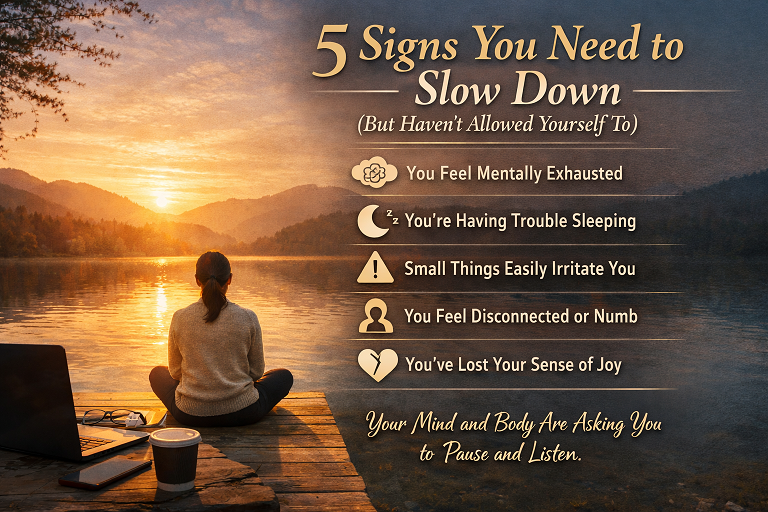
There is a quiet conversation your body and mind have been trying to have with you. You have been too busy to hear it.
You wake up already behind. You move through your days at a pace that feels necessary, productive, even virtuous. Slowing down feels like a luxury you cannot afford, a reward you have not yet earned, or worse — a sign of weakness. So you push through the tiredness. You scroll through the discomfort. You stay busy so you do not have to feel whatever is sitting just underneath the surface of all that movement.
But here is what no one tells you: the need to slow down is not a character flaw. It is not laziness dressed up in self-care language. It is your nervous system, your intuition, and your deepest intelligence asking you — sometimes begging you — to return to yourself.
At Still Alchemy, we believe that stillness is not the absence of living. It is the very foundation of it. The alchemy happens not in the doing, but in the being. And before transformation can occur, you have to be honest about where you actually are.
So let us talk about the signs. Not the obvious ones like “I am tired” or “I feel stressed” — those are the surface symptoms most people dismiss with a second cup of coffee. These are the deeper, quieter, often misread signals that your body and mind send when the pace you are keeping has become unsustainable.
Sign #1: Your Body Is Sending Constant SOS Signals You Keep Ignoring
The body speaks first. It always does. Long before the mind admits that something is wrong, the body has been whispering — and then escalating to a shout — that it desperately needs rest and restoration.
Chronic tension in the jaw, neck, and shoulders is one of the most common physical signs of a nervous system that has been running on high alert for too long. Many people carry this tension so habitually that they no longer notice it until a massage therapist presses on a knot and they wince in surprise. Headaches that appear regularly, particularly tension headaches that settle behind the eyes or across the temples, are another signal. So are digestive issues — the gut is extraordinarily sensitive to chronic stress, and conditions like irritable bowel syndrome, bloating, and unexplained stomach pain are frequently rooted in an overactivated stress response.
Sleep disturbances are perhaps the most telling sign of all. When you cannot fall asleep despite being exhausted, when you wake at 3 a.m. with your mind already racing, when no amount of sleep seems to leave you feeling rested — your body is telling you that something is fundamentally dysregulated. Research published in the journal Sleep Medicine Reviews has shown that chronic sleep disruption is both a cause and a consequence of a dysregulated stress response. The mind cannot downshift because the pace of life has not given it permission to.
Perhaps the most overlooked physical signal is getting sick frequently. When the immune system is chronically suppressed by elevated cortisol — the body’s primary stress hormone — it becomes less effective at fighting off infection. If you find yourself catching every cold that goes around, experiencing more frequent flare-ups of existing health conditions, or simply never feeling quite well, your body is allocating its resources to managing stress rather than maintaining health.
What makes this sign so easy to dismiss is that we live in a culture that celebrates pushing through physical discomfort. “Mind over matter” is treated as a virtue. But the body is not the enemy of your ambitions — it is the vessel through which your entire life is lived. When you ignore its signals, it simply turns up the volume. And eventually, it forces a stop that you did not choose.
The Still Practice: Spend five minutes each morning doing a slow, deliberate body scan before you reach for your phone. Place one hand on your chest and one on your belly. Notice where you are holding tension. Notice the quality of your breath. This is not meditation for the sake of achieving a meditative state — it is simply learning to listen again.
Sign #2: You Cannot Be Present for More Than a Few Minutes at a Time
Think about the last time you were truly, completely present. Not half-present while also mentally composing a to-do list. Not technically in the room while your attention was elsewhere. Fully present — where the moment you were in was the only moment that mattered.
If you struggle to recall such a time, or if it feels like a distant memory, you are experiencing one of the most pervasive signs of a life moving too fast.
Researchers at Harvard University found in a landmark study that people spend nearly 47 percent of their waking hours thinking about something other than what they are currently doing. The study, published in Science, found that this mind-wandering — regardless of what people were thinking about — was associated with lower levels of happiness. The inability to be present is not just a philosophical inconvenience. It is measurably eroding your quality of life.
When the pace of life becomes relentless, the mind develops a habit of living in the future or the past. You are eating dinner but you are thinking about tomorrow’s meeting. You are having a conversation but you are already formulating your response. You are supposed to be relaxing but you are cataloguing everything that still needs to be done. This hyperactive mental activity is the mind’s attempt to stay ahead of a schedule that keeps demanding more.
You might notice this as an inability to enjoy things you used to love. Activities that once brought genuine pleasure — reading a book, cooking a meal, spending time in nature — start to feel restless and unsatisfying because you cannot settle into them. You reach for your phone not because you want to, but because the discomfort of simply being without stimulation has become unbearable.
Chronic busyness also rewires the brain’s reward system. When you are constantly task-switching, your brain releases small hits of dopamine with each completed item, each notification, each new input. Over time, stillness starts to feel boring — even threatening — because the brain has been conditioned to equate stimulation with value. But this is not a personality trait. It is a pattern. And patterns can be changed.
Presence is not something you can force. It is something you create the conditions for. And slowing down is how you create those conditions.
The Still Practice: Choose one daily activity — a meal, your morning coffee, a walk — and commit to doing it without your phone, without music, and without multitasking for a full week. Notice the resistance. Notice what surfaces in the quiet. That discomfort is not a sign that you are doing it wrong. It is a sign that you needed this.
Sign #3: Your Emotional Responses Feel Out of Proportion or Numb
When was the last time you cried and were not sure why? When was the last time you snapped at someone you love over something objectively small, then felt immediate shame? Or conversely — when was the last time something genuinely beautiful or joyful happened and you felt… nothing?
Both extremes — emotional volatility and emotional numbness — are signs of a nervous system that has been pushed beyond its capacity for too long.
The science behind this is straightforward. The prefrontal cortex, the part of the brain responsible for rational thought, perspective-taking, and emotional regulation, requires adequate rest and low-stress conditions to function well. When cortisol levels are chronically elevated — as they are in states of sustained overwhelm — the prefrontal cortex’s effectiveness is compromised, and the amygdala, the brain’s threat-detection center, becomes more reactive. The result is that minor frustrations feel catastrophic, small setbacks trigger disproportionate distress, and emotional regulation feels genuinely impossible.
Many people who are running too fast also develop what is sometimes called functional numbness — a flattening of the emotional landscape. This is the body’s protective mechanism against overwhelm. When there is simply too much to feel and no time or space to feel it, the system partially shuts down. Joy becomes muted. Excitement becomes hard to access. Tenderness feels far away. People in this state often describe feeling like they are watching their life from behind glass, going through the motions without really inhabiting them.
It is important to distinguish this from clinical depression, which requires professional care and is a distinct condition. But the emotional flatness that comes from sustained overactivation and under-rest is extraordinarily common, and it is one of the body’s clearest signs that something needs to change.
Crying without knowing why — what some call emotional overflow — is actually a sign of a system releasing what it has been storing. Many people who finally take a long vacation, or who sit in stillness for the first time in months, find themselves unexpectedly tearful. This is not a breakdown. It is a beginning.
The Still Practice: Create a brief daily check-in ritual — even two minutes — where you genuinely ask yourself how you are feeling, not as a social formality but as a real inquiry. Name the emotion, even if it is vague. Research on emotional granularity, pioneered by psychologist Lisa Feldman Barrett, shows that the simple act of accurately naming your emotional state activates the prefrontal cortex and calms the amygdala. Naming what you feel is not indulgent. It is neurologically regulating.
Sign #4: Your Relationships Are Running on Fumes
You love the people in your life. That love has not gone anywhere. But somewhere along the way, your presence in those relationships has become thin — stretched across too many obligations, too many distractions, too much to carry.
You are there, but not quite there. You listen, but not deeply. You show up, but often from a place of depletion rather than genuine fullness. And in quieter moments, you might feel a low-grade guilt about it — a sense that the people who matter most are getting the leftover version of you.
This is one of the most painful and least-discussed signs that you need to slow down. It is painful because relationships are where our deepest meaning lives. It is underdiscussed because it is easy to rationalize: you are working this hard for your family. You are this busy because you care. But the people who love you do not need the fruits of your busyness as much as they need your actual attention.
Research consistently shows that the quality of our close relationships is the single strongest predictor of long-term health and happiness — more powerful than wealth, fame, or professional achievement. The Harvard Study of Adult Development, one of the longest-running studies on human happiness ever conducted, found across 80-plus years that it was the warmth and depth of personal relationships that most reliably predicted who would live long, healthy, flourishing lives.
When you are chronically overextended, you bring a depleted, defended, distracted version of yourself to your relationships. You are more irritable, less patient, less curious about other people’s inner lives. Small misunderstandings become conflicts because there is no buffer of ease to absorb them. Physical and emotional intimacy recede because genuine connection requires a quality of presence you are struggling to access.
Children are particularly sensitive to this. A parent who is physically present but mentally absent is a source of subtle anxiety for a child, even if they cannot articulate it. Partners feel it too — the sense of being in the room with someone who is not really there.
The Still Practice: Designate one evening per week as a true no-devices, no-agenda time with the people you love. Not an activity you are doing together with the TV on in the background. A genuine gathering of attention. Cook together, talk, play, sit. Let the conversation go where it wants to. This is not about creating a perfect moment. It is about practicing the art of showing up.
Sign #5: Rest Does Not Actually Feel Like Rest Anymore
Perhaps the most telling sign of all, and the one that most people in our culture have come to accept as normal: you do not know how to rest.
You take a vacation and spend the first three days anxious and restless, unable to stop checking your email, unable to turn off the internal planner that keeps cataloguing what you should be doing. You sit down to watch television and find yourself simultaneously scrolling your phone, planning, or working through a problem in your head. You take a bath but your mind is at the office. You sleep but you wake up tired.
Rest has been colonized by productivity culture. We have turned even our leisure into something that needs to be optimized, curated, and performed. The wellness industry — which is not without its own contradictions — has given us the concept of “productive rest,” as if resting for its own sake is not sufficient justification. We meditate to perform better at work. We exercise to increase our output. We sleep-track to improve our metrics.
But true rest — the kind that actually restores — is not efficient. It is not purposeful in the way we have been conditioned to understand purpose. It is simply the experience of the nervous system downshifting, the mind releasing its grip on outcomes, the body feeling safe enough to fully let go.
Psychologists distinguish between passive rest, which involves low-stimulation activities like sitting quietly, and active rest, which involves gentle engagement that does not tax the stress response — walking in nature, creative play, gentle movement, unhurried conversation. Both are valuable. What neither of them looks like is scrolling through a social media feed, which research has consistently shown activates the brain’s threat-detection systems through social comparison, negative news, and the dopamine loop of intermittent reward.
If you cannot rest without feeling guilty, restless, or compelled to be doing something, it is not a scheduling problem. It is a belief problem. Somewhere beneath the busyness is a conviction — often unconscious — that your worth is contingent on your output. That stopping is a betrayal of the ambition or responsibility you have claimed as your identity. That stillness is something you have to earn, not something you are inherently allowed to inhabit.
You are allowed to rest. Not because you have earned it. Because you are a living being, and living beings require rest the way they require water.
The Still Practice: Experiment with doing nothing for ten minutes a day. Not meditating — just sitting. No phone, no task, no goal. Allow boredom. Allow the mind to wander. Allow rest to feel purposeless. Notice the quality of discomfort this produces, and know that this discomfort is precisely the evidence that this practice is necessary.
Why We Resist Slowing Down (And What That Resistance Is Really About)
Understanding the signs is one thing. Understanding why we resist them is another, and arguably more important.
We live in a culture that has made busyness synonymous with worth. To be busy is to be needed, to be contributing, to matter. The phrase “I have been so busy” has become a status symbol — evidence that you are important, that your time is in demand, that you are doing life right.
This cultural narrative runs deep, and it is reinforced constantly. By workplaces that reward presence over results. By social feeds that curate highlight reels of constant productivity and achievement. By the internalized belief, absorbed from childhood in many cases, that love and approval are conditional on performance.
Slowing down can feel dangerous when your sense of identity is built on momentum. If you stop moving, you might have to feel what you have been outrunning. You might have to sit with the question of whether the life you are living is actually the life you want. You might have to confront the grief, the longing, the fear, or the deep tiredness that has been waiting quietly beneath the noise.
This is why slowing down is not simply a lifestyle choice. It is, in many cases, an act of profound courage. It asks you to trust that you are enough even when you are still. That your value is not contingent on your velocity. That the person underneath all the doing is worth spending time with.
The Alchemy of Stillness
Alchemy, at its ancient core, was the practice of transforming base matter into something refined and luminous. The alchemists believed that within every substance was the potential for gold — not literal gold, but the highest expression of what that substance was capable of becoming.
The same is true of you.
But transformation does not happen in the noise. It happens in the quiet. In the pause. In the moment when you finally stop moving long enough to hear what you actually know.
This is the alchemy of stillness: the discovery that what you were searching for in the relentless forward motion was available to you all along, in the very thing you were running from. The rest. The silence. The present moment. Yourself.
The five signs we have explored in this article are not verdicts. They are invitations. Invitations to do something genuinely countercultural and deeply necessary — to slow down, not as a temporary strategy for optimizing your performance, but as a fundamental reorientation toward how you want to live.
You do not have to overhaul your life overnight. You do not have to achieve perfect stillness. You simply have to be willing to begin.
One breath at a time. One moment at a time. One small, deliberate act of slowing down.
That is where the alchemy begins.
How Still Alchemy Supports Your Return to Yourself
At Still Alchemy, we exist at the intersection of stillness and transformation. We understand that modern life makes it genuinely difficult to slow down — and that the resistance most people feel is not personal weakness, but the natural result of living in a culture that has made busyness a virtue and rest a luxury.
Our work is rooted in the belief that stillness is not the opposite of a full life. It is the foundation of one. Through our content, practices, and resources, we offer what we like to call “entry points into the quiet” — practical, grounded, accessible ways to begin reclaiming the pace that is right for you, not the pace the world has defaulted you into.
Whether you are in the early stages of recognizing that something needs to shift, or you are deep in the work of rebuilding your relationship with rest, presence, and intentional living, you belong here. Still Alchemy is not about perfection. It is not about arriving at some enlightened state of permanent tranquility. It is about learning to hear yourself again. About developing the inner capacity to move through life with more grace, more awareness, and more genuine peace.
The gold was never in the movement. It was always in the stillness. We are here to help you find your way back to it.
You must be logged in to post a comment.