
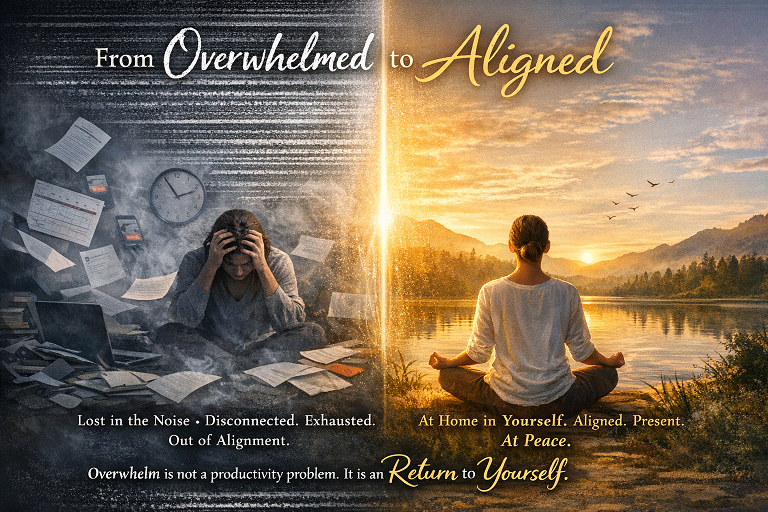
A Simple Path Back to Yourself
There is a particular kind of exhaustion that has nothing to do with sleep. You can rest all weekend and still wake up Monday morning feeling like something essential has gone quiet inside you — like the signal that used to guide you has been overtaken by static. This is what overwhelm truly is: not just too much to do, but too much distance between who you are and how you are living.
Table of Contents:
Most conversations about overwhelm start and end with productivity tips. Make a to-do list. Prioritize. Delegate. And while those tools have their place, they miss the deeper truth: the overwhelm most of us carry is not a scheduling problem. It is an alignment problem. It is the invisible weight of living out of sync with your values, your body, your intuition, and your inner stillness.
This piece is not about doing more. It is about returning — gently, honestly, and practically — to yourself.
What Overwhelm Is Really Telling You
Before you try to fix overwhelm, it helps to understand what it actually is. Overwhelm is not weakness. It is not a character flaw or a sign that you cannot cope. It is information. It is your nervous system, your soul, your entire inner world waving a flag and saying: something here is not aligned.
Neurologically, overwhelm occurs when the prefrontal cortex — the part of the brain responsible for decision-making, planning, and emotional regulation — becomes flooded with competing demands. The amygdala, your brain’s threat-detection center, interprets this flood as danger and triggers a stress response. The result is that familiar state where you feel frozen, scattered, reactive, and disconnected all at once.
But beyond the neuroscience, overwhelm has a spiritual and emotional dimension that is rarely discussed. When you are consistently overwhelmed, you are often living in one or more of the following states:
Disconnection from your values. When your daily life does not reflect what you genuinely care about, there is a constant low-level friction that drains energy without you ever quite understanding why.
Disconnection from your body. Many people under chronic stress essentially lose contact with their physical selves. They live from the neck up, ignoring the signals their bodies send — tightness in the chest, shallow breathing, disrupted sleep — until the signals become impossible to ignore.
Disconnection from stillness. In a world that rewards constant output, many of us have forgotten how to simply be. The noise of doing has drowned out the wisdom of being.
Over-identification with the roles you play. You are a partner, a parent, a professional, a friend. When these roles stack up without space for your own inner life, you lose the thread back to your essential self — the you that exists beneath all of those labels.
Overwhelm, then, is the gap between the life you are living and the life your soul is asking for. The path back to yourself begins the moment you stop treating it as a problem to be managed and start treating it as a message to be heard.
The Alchemy of Stillness
There is a reason the word alchemy has endured for centuries. Alchemy is the art of transformation — of turning something raw and chaotic into something refined and radiant. The ancient alchemists sought to transmute lead into gold. What we are talking about here is something more profound: transmuting overwhelm into alignment, noise into clarity, fragmentation into wholeness.
And the agent of that transformation is stillness.
Stillness is not the absence of thought or feeling. It is not a blank mind or a silenced life. True stillness is a quality of presence — a deep internal settledness that allows you to hold everything life brings without being swept away by it. It is the still point at the center of the turning world.
Research consistently shows that practices cultivating stillness — meditation, breathwork, contemplative movement, time in nature — do not merely reduce stress. They rewire the brain. Regular practitioners show measurable increases in gray matter density in the prefrontal cortex, improved emotional regulation, and reduced activity in the default mode network, the part of the brain responsible for rumination and mental chatter. Stillness is not just a spiritual ideal. It is a neurological reality that you can cultivate with practice.
But perhaps more importantly, stillness creates the conditions for something that no algorithm can deliver: access to your own inner knowing. When the noise quiets, even briefly, you begin to hear the soft and steady voice of your authentic self — the part of you that already knows what you value, what you need, and what needs to change.
Recognizing the Signs of Misalignment
Before you can find your way back to yourself, you need to recognize when you have drifted. Misalignment is often gradual and subtle. It rarely announces itself loudly. Instead, it shows up in small, persistent ways:
You feel perpetually busy but rarely fulfilled. You finish one thing and immediately move to the next without any sense of satisfaction or completion. You find yourself saying yes when every part of you wants to say no. You feel a quiet but persistent sense of unease, as though something is off but you cannot quite name it. Sleep does not restore you. Joy feels distant or effortful. You feel most like yourself only in fleeting moments — and then the feeling slips away again.
These are not signs of failure. They are signals of misalignment. They are your inner compass telling you that the direction you are moving does not match the direction your soul is meant to go.
One of the most honest diagnostic questions you can ask yourself is this: When did I last feel genuinely at peace — not relaxed because I was entertained, but deeply, quietly at peace because I was simply being myself?
If you cannot remember, the path back begins with creating that space again, even in the smallest ways.
The Path Back: Seven Practices for Returning to Alignment
The journey from overwhelmed to aligned is not a single dramatic shift. It is a series of small, intentional returns to yourself — practiced daily, gently, and without self-judgment. Here is a path that integrates ancient wisdom with modern understanding.
1. Come Back to the Body
The body is your most honest oracle. It holds truths your mind may be working overtime to avoid. When you are overwhelmed, your body is almost always speaking loudly — through tension, fatigue, constriction, or pain. The first step back to yourself is not a thought. It is a breath.
Begin with one conscious breath whenever you notice you have been swept away. Inhale through the nose for a count of four, hold gently for four, and exhale slowly for six to eight counts. This elongated exhale activates the parasympathetic nervous system, signaling to your body that you are safe. It is not a cure. But it is a door — and every door back to yourself matters.
From breath, move into body awareness. Place one hand on your heart and one on your belly. Feel the warmth of your own hands. Notice what is present: tightness, ease, emotion, neutrality. You are not trying to change anything. You are simply arriving back in your body, which is the only place the present moment actually exists.
2. Practice the Pause
One of the most transformative — and one of the most underrated — practices available to any human being is the deliberate pause. Before you respond to an email, reach for your phone, accept a request, or launch into your next task, pause. Even for three seconds.
The pause is not passive. It is a micro-moment of self-consultation. It asks: Is this aligned? Does this serve me? Is this where my energy belongs right now?
Over time, the pause builds what psychologists call the observing self — the part of you that can notice your own thoughts and impulses without immediately becoming them. This is the seat of genuine agency, and it is only accessible through stillness.
3. Return to Your Values
Overwhelm often signals a life being lived from obligation rather than intention. Getting back to yourself requires knowing — not abstractly, but viscerally — what you actually value.
Not what you think you should value. Not what looks good on a vision board. What you genuinely, honestly, in your bones care about.
Take a quiet moment and ask yourself: What matters most to me? Let the answers be simple. Connection. Creativity. Honesty. Freedom. Service. Peace. Write them down. Then look at how you spent the last seven days and notice the gap between what you named and how you actually lived.
That gap is not cause for shame. It is the map. It shows you where to begin redirecting your energy.
4. Simplify Before You Add
There is a deeply ingrained cultural story that the solution to feeling lost is to add more: more practices, more goals, more self-improvement. But often the path back to yourself requires subtracting — removing the commitments, relationships, habits, and mental clutter that are keeping you from your own center.
Before you add anything to your life, ask: What can I release? What obligation are you honoring out of guilt rather than genuine care? What relationship drains more than it nourishes? What habit keeps you from stillness — the late-night scrolling, the compulsive busyness, the yes when you mean no?
Every act of conscious simplification creates space. And space is where alignment grows.
5. Cultivate a Daily Stillness Practice
You do not need an hour. You do not need a meditation cushion, a sacred space, or a teacher. You need five minutes and a willingness to stop.
A stillness practice can take many forms: seated meditation, breathwork, a slow morning walk without earbuds, a few minutes of journaling before the day begins, movement practices like yoga, tai chi, or qigong that integrate body and breath. What matters is not the form but the intention — to stop the outward momentum and turn inward, even briefly, every day.
The science here is unambiguous. Even brief daily mindfulness practice measurably reduces cortisol, improves emotional regulation, and increases the sense of well-being over time. But beyond the research, a daily stillness practice does something that cannot be measured: it builds a relationship with yourself. It tells the deepest part of you, I am paying attention. You matter. I am here.
6. Tend to Your Inner Dialogue
The voice inside your head is not a neutral narrator. For many people living in chronic overwhelm, the inner voice is a relentless critic — cataloguing every mistake, anticipating every failure, measuring every effort against an impossible standard of enough.
Returning to yourself requires befriending that voice without believing everything it says. Self-compassion — the practice of treating yourself with the same care and understanding you would offer a close friend in distress — has been shown in extensive research by psychologist Dr. Kristin Neff to reduce anxiety, depression, and burnout while increasing resilience, motivation, and well-being.
This is not about toxic positivity or forcing false cheerfulness. It is about recognizing that suffering is part of shared human experience, that you are not uniquely flawed or broken, and that you deserve kindness from yourself — especially when things are hard.
When you notice the inner critic running its commentary, try a simple shift: What would I say to someone I love who was feeling this way? Then say that to yourself.
7. Create Rituals of Return
Human beings are ritual creatures. Across every culture and throughout all of recorded history, we have used ritual to mark transitions, create meaning, and return to what is sacred. In a modern life that often moves too fast for meaning to settle, rituals act as anchors — small, consistent practices that pull you back to yourself when the current of daily life has carried you away.
A ritual does not need to be elaborate. It can be as simple as a cup of tea prepared with full attention. A few minutes of journaling at the end of each day. A breath before you eat. A moment of genuine gratitude before sleep. These are not superstitions or productivity hacks. They are acts of self-reverence — ways of telling yourself and the world: I am here. I am present. I belong to myself first.
The Role of Community in Coming Home to Yourself
There is a paradox at the heart of inner alignment: the most profound inner work is often done in relationship. We are deeply social beings, and isolation — whether physical or emotional — compounds overwhelm rather than relieving it. Finding or building a community that supports your inner life rather than consuming it is part of the path back to yourself.
This means being discerning about whose voices you let in. Not every community nourishes your growth. Seek those who celebrate your becoming, who hold space for both your light and your shadow, and who are themselves doing the work of conscious living.
It also means being honest about where you have been hiding yourself — holding back your authentic voice, performing rather than participating, shrinking to keep others comfortable. Alignment is not just an inside job. It asks you to show up as yourself in the world, even when that is uncomfortable.
How Still Alchemy Supports Your Path
At Still Alchemy, we understand this journey from the inside out. The name itself speaks to what is possible: still — the quality of presence and quiet that makes transformation available; alchemy — the deep, sacred work of turning what feels broken into something whole.
We exist for those who are done with surface-level solutions and ready for real inner work. Our content, offerings, and community are rooted in the understanding that you are not a productivity problem to be solved. You are a human being in the ongoing process of awakening to yourself — and that process deserves support, wisdom, and a space that honors its depth.
Whether you are just beginning to notice the gap between where you are and who you truly are, or you have been on this path for years and need tools to go deeper, Still Alchemy is here as a companion on the way. We draw on the wisdom of mindfulness, somatic awareness, contemplative traditions, and the lived experience of coming back to ourselves again and again — because this path is not walked once. It is walked daily, with devotion.
You do not have to have everything figured out to begin. You only have to be willing to return.
The Truth About Alignment
Alignment is not a destination you arrive at and then get to keep forever. It is not a state of perpetual bliss or a life free from difficulty. The fully aligned life still has grief in it, still has uncertainty, still has moments where you feel lost.
What changes is your relationship to those moments. When you are aligned — when your daily life reflects your values, when you have a practice that keeps you connected to your inner stillness, when you treat yourself with compassion and are honest about what you need — you are not bulletproof. But you are rooted. And a rooted person can bend in the wind without breaking. A rooted person can be swept by emotion without losing themselves in it. A rooted person knows, in the deepest place, who they are.
This is what we are really talking about when we talk about coming home to yourself. Not perfection. Not the end of struggle. But an unshakeable knowing of who you are beneath all the noise — and the practices, the community, and the willingness to keep returning to that place, again and again, for the rest of your life.
The path is simple. Not always easy. But simple. Take one breath. Pause. Listen. Return.
You know the way. You have always known the way.
You must be logged in to post a comment.