
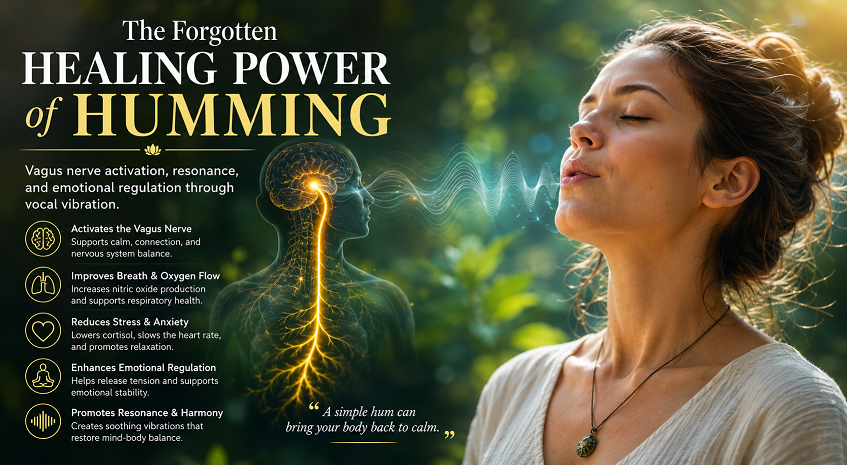
In a world filled with noise, stress, overstimulation, and constant mental activity, one of the most powerful healing tools available to human beings is also one of the simplest: humming.
Long before modern neuroscience began studying the effects of vibration, resonance, and sound on the nervous system, cultures around the world used humming-like vocal tones in prayer, meditation, ritual, and healing. Monks chanted. Indigenous communities used tonal vocalizations. Mothers hummed to calm infants. Spiritual traditions incorporated repetitive sounds to create inner stillness and emotional balance.
Today, science is beginning to explain why humming feels calming, grounding, and emotionally regulating. What once seemed mystical now has measurable physiological effects tied to the vagus nerve, breath regulation, resonance, nitric oxide production, and the nervous system itself.
Humming is more than a sound. It is a form of internal vibration therapy created by the human body.
The beauty of humming is that it requires no equipment, no special training, and no perfect voice. Anyone can do it. And for many people, it may be one of the most accessible ways to calm anxiety, regulate emotions, improve focus, and reconnect with the body.
Why Humming Feels So Calming
Most people have experienced the soothing effect of humming without thinking deeply about it.
People hum while cooking, driving, rocking a baby, cleaning the house, meditating, or relaxing. Many people even hum unconsciously when trying to comfort themselves during stress.
This instinctive behavior is not random.
Humming naturally slows the breath, stimulates vibration through the chest and skull, and activates the parasympathetic nervous system — the branch of the nervous system associated with rest, recovery, digestion, healing, and emotional regulation.
Unlike speaking, humming creates continuous resonance within the body. The sound waves generated by the vocal cords travel internally through tissues, bones, air cavities, and the nervous system itself.
This internal vibration appears to influence physiological states in several ways:
- Slowing respiration
- Increasing vagal tone
- Reducing stress response
- Encouraging emotional release
- Improving focus and presence
- Enhancing relaxation
- Supporting social bonding and feelings of safety
For something so simple, the effects can be surprisingly profound.
Understanding the Vagus Nerve
To understand why humming can feel deeply healing, it helps to understand the vagus nerve.
The vagus nerve is the longest cranial nerve in the body. It travels from the brainstem through the face, throat, heart, lungs, and digestive organs, forming a major communication pathway between the brain and body.
The word “vagus” comes from Latin and means “wandering,” which is fitting because the nerve wanders throughout much of the body.
The vagus nerve plays a central role in:
- Heart rate regulation
- Breathing
- Digestion
- Immune response
- Emotional regulation
- Stress recovery
- Social engagement
- Feelings of safety and calm
When the vagus nerve functions well, the body can transition more easily out of stress states. When vagal tone is low, people may feel chronically anxious, emotionally reactive, exhausted, disconnected, or stuck in fight-or-flight mode.
Modern life places enormous strain on the nervous system. Constant stimulation, emotional stress, poor sleep, trauma exposure, social disconnection, and digital overload can all dysregulate the vagal system.
Practices that gently stimulate the vagus nerve are now receiving increased scientific attention because they may help restore nervous system balance naturally.
Humming is one of those practices.
How Humming Stimulates the Vagus Nerve
The vagus nerve has branches connected to the throat, vocal cords, ears, diaphragm, and facial muscles. Because humming engages many of these areas simultaneously, it may provide a direct pathway for vagal stimulation.
When you hum:
- The vocal cords vibrate
- The throat muscles activate rhythmically
- Breathing slows naturally
- Exhalation lengthens
- Resonance travels through facial bones and tissues
- The diaphragm moves steadily
- Auditory feedback loops engage the brain
These combined effects create conditions associated with parasympathetic activation.
One reason extended exhalation matters is because the nervous system often associates slow exhalation with safety. During stress, breathing becomes shallow and rapid. During calm states, breathing slows and deepens.
Humming automatically encourages longer exhalations because the sound continues while air slowly leaves the body.
This alone can shift physiological state.
Some researchers also believe vibration near the larynx and vocal tract may mechanically influence vagal pathways, though the full mechanisms are still being explored.
What is clear is that many people report measurable calming effects after only a few minutes of humming.
The Polyvagal Perspective
The growing popularity of polyvagal theory has brought renewed attention to practices like humming.
Polyvagal theory, developed by neuroscientist Stephen Porges, explores how the nervous system constantly scans for cues of safety or danger. According to the theory, humans move between different physiological states depending on how safe or threatened they feel.
When people feel safe, they enter a socially engaged state associated with connection, emotional flexibility, curiosity, and calm.
When they feel threatened, they may shift into fight-or-flight activation or shutdown responses.
The voice plays a major role in this system.
Tone, rhythm, vibration, and vocalization are deeply connected to nervous system regulation. This may explain why soothing voices calm people and harsh tones create tension.
Humming creates self-generated vocal safety cues.
The body hears and feels its own resonance internally. This may help signal safety to the nervous system in a way that is deeply primal and biological.
For people experiencing chronic stress, anxiety, trauma, or emotional overwhelm, this kind of gentle self-generated regulation can be powerful.
Resonance: The Body as a Vibrating Instrument
Every part of the body vibrates.
The heart produces rhythm. The brain generates electrical oscillations. Cells communicate through electrical signaling. Sound itself is vibration moving through matter.
When humans hum, the body becomes an acoustic chamber.
Different tones create resonance in different areas:
- Lower tones often vibrate in the chest
- Mid-tones resonate in the throat
- Higher tones may vibrate through the face and skull
Many people notice tingling sensations around the lips, nose, jaw, or chest while humming. These sensations reflect the movement of vibration through tissues and bone conduction pathways.
This internal resonance may help increase bodily awareness and interoception — the ability to sense internal states.
Interoception is closely tied to emotional regulation. People who are disconnected from bodily sensations often struggle to recognize stress signals until they become overwhelming.
Humming encourages people to feel themselves from the inside.
In many ways, it acts as a bridge between mind and body.
Humming and Emotional Regulation
Emotions are not purely mental experiences. They are physiological states involving hormones, muscles, breathing patterns, heart rhythms, and nervous system activation.
When emotions become intense, the body often reflects it physically:
- Tight chest
- Rapid breathing
- Clenched jaw
- Racing heart
- Digestive discomfort
- Muscle tension
Traditional approaches to emotional regulation often focus only on thinking differently. But the nervous system frequently requires physical regulation, not just cognitive insight.
Humming offers a bottom-up approach.
Instead of trying to force calm through thought alone, humming changes physiological conditions directly.
People often describe:
- Reduced anxiety
- Emotional softening
- Decreased panic intensity
- Greater grounding
- Improved mood
- Less mental racing
- Easier access to meditation
This does not mean humming eliminates deep emotional wounds or trauma. But it may help create enough nervous system stability for healing work to become more accessible.
Many therapists and somatic practitioners now integrate vocal toning, humming, chanting, and breathwork into emotional healing practices for this reason.
The Link Between Humming and Nitric Oxide
One of the most fascinating discoveries surrounding humming involves nitric oxide.
Nitric oxide is a signaling molecule involved in:
- Blood flow
- Immune function
- Oxygen delivery
- Inflammation regulation
- Sinus health
Research has shown that humming dramatically increases nitric oxide production in the nasal passages compared to quiet breathing.
This may happen because humming creates oscillating air vibrations within the sinuses, increasing gas exchange and airflow.
Nitric oxide has antimicrobial properties and plays an important role in respiratory health.
Some researchers believe this may partly explain why nasal breathing practices are associated with improved physiological regulation and relaxation.
Humming may therefore provide both neurological and respiratory benefits simultaneously.
Why Humming Feels Ancient
Humming often creates a strangely familiar feeling, even for people who have never practiced sound healing.
That may be because humans have used vocal resonance therapeutically for thousands of years.
Ancient chanting traditions exist across cultures:
- Gregorian chants
- Buddhist chanting
- Vedic mantras
- Indigenous vocal ceremonies
- Sufi devotional singing
- African communal singing traditions
Many of these practices rely on sustained tones, repetition, rhythm, and resonance.
Modern neuroscience increasingly supports the idea that repetitive vocalization can synchronize breathing, calm the nervous system, and promote group bonding.
When people sing or hum together, heart rhythms and breathing patterns can even begin to synchronize.
This collective resonance may help explain why communal singing often feels emotionally powerful and healing.
Long before humans understood neuroscience, they understood vibration experientially.
Humming as Self-Soothing
One of the most interesting aspects of humming is that humans naturally do it during self-soothing moments.
Parents hum to babies.
People hum while grieving.
Children hum when anxious.
Individuals hum unconsciously while concentrating.
These behaviors likely emerge because humming regulates physiological arousal automatically.
In infants, vocal soothing helps regulate undeveloped nervous systems. Babies cannot calm themselves alone; they co-regulate through touch, voice, rhythm, and presence.
Adults still retain this biological wiring.
A calm voice — including one’s own — can become a nervous system stabilizer.
This may be especially important in a world where many people feel chronically dysregulated and disconnected from embodied calm.
The Science of Vocal Toning
Humming belongs to a broader category of practices sometimes called vocal toning.
Vocal toning involves sustained vocal sounds designed to create resonance within the body. Unlike singing, it focuses less on melody and more on vibration and sustained tones.
Some sound therapists use vowel sounds such as:
- “Om”
- “Ah”
- “Oo”
- “Ee”
- “Mmm”
Each creates slightly different resonant patterns.
The “mmm” sound associated with humming is particularly calming because it:
- Encourages closed-mouth nasal resonance
- Extends exhalation
- Produces strong facial vibration
- Activates bone conduction pathways
Even brief humming sessions may alter mood and physiological state.
Many people notice effects within minutes.
Humming and Meditation
For people who struggle with silent meditation, humming can provide an easier entry point.
Silence can feel intimidating when the mind is racing. Humming gives the brain something rhythmic and sensory to focus on.
The vibration anchors attention in the present moment.
Because humming occupies both breath and auditory awareness, it reduces mental wandering for many individuals.
Some meditation traditions intentionally use repetitive sound because rhythm and resonance naturally stabilize attention.
Humming meditation may include:
- Slow breathing
- Closed eyes
- Sustained humming tones
- Awareness of vibration
- Focus on bodily sensation
Even five to ten minutes can feel deeply centering.
The Relationship Between Humming and Trauma Recovery
Trauma is not only stored as memory. It also affects nervous system patterns.
People with trauma histories often experience:
- Hypervigilance
- Chronic tension
- Dysregulated breathing
- Emotional overwhelm
- Shutdown states
- Difficulty feeling safe in the body
Practices that emphasize safety, pacing, and bodily awareness are increasingly valued in trauma-informed healing approaches.
Humming can be useful because it is:
- Gentle
- Non-invasive
- Self-directed
- Rhythmic
- Breath-centered
- Grounding
Importantly, humming does not require verbal processing. For some individuals, talking about emotions can initially intensify dysregulation.
Vibration-based practices may offer a different doorway into regulation.
However, trauma healing is highly individual. Humming is not a replacement for professional support when needed, especially for severe trauma or mental health conditions.
Still, many people find it to be a supportive complementary practice.
Why Modern Society Forgot Humming
Modern culture often separates healing from ordinary human behavior.
Simple practices tend to be overlooked because they are not commercialized, technologically advanced, or dramatic.
Yet many ancient regulatory behaviors remain biologically effective:
- Breathing slowly
- Walking barefoot
- Singing together
- Rhythmic movement
- Touch
- Deep rest
- Vocal resonance
Humming may have faded from modern awareness partly because it seems too simple to matter.
But the nervous system evolved in response to rhythm, sound, breath, and social connection — not constant digital stimulation.
Many people today spend hours consuming external noise while rarely producing intentional sound themselves.
Humming reverses that pattern. It creates internal sound instead of external overload.
Practical Ways to Use Humming for Regulation
Humming does not need to become a complicated ritual.
Simple approaches are often most effective.
Morning Nervous System Reset
Begin the day with five minutes of slow humming before checking devices or social media.
This can help establish calm baseline regulation before external stress enters the nervous system.
Stress Interruption
When anxiety rises, try:
- Inhaling slowly through the nose
- Humming gently during exhalation
- Repeating for several minutes
Notice where vibration is felt most strongly.
Humming Before Sleep
Gentle humming at night may help reduce mental overactivity and support relaxation before bed.
Lower tones are often especially calming.
Walking Humming Meditation
Soft humming while walking can synchronize breath, movement, and rhythm.
This may increase grounding and bodily presence.
Group Humming
Humming with others creates shared resonance and social regulation.
Many people experience a strong emotional release during collective vocal practices.
The Psychological Importance of Using Your Voice
There is also symbolic importance in vocal expression.
Many people suppress their voices emotionally:
- Fear of judgment
- Fear of being heard
- Shame
- Social conditioning
- Trauma
- Chronic stress
Humming is a gentle form of reclaiming vocal expression without the pressure of speaking or singing perfectly.
It reminds the body that sound itself can be safe.
For some individuals, this can become emotionally meaningful.
Humming, Frequency, and Sound Healing
Modern sound healing communities often discuss frequency and resonance. While some claims in the wellness space become exaggerated or scientifically unsupported, the broader principle that sound affects physiology is legitimate.
Sound changes nervous system states.
Rhythm influences brain activity.
Vibration affects tissue mechanically.
Music alters mood and hormone levels.
Humming represents one of the most biologically direct forms of sound interaction because the source of vibration comes from within the body itself.
Unlike external music, humming creates internal resonance through self-generated vibration.
This distinction may partly explain why it feels uniquely grounding and regulating.
The Future of Vagal Sound Practices
As interest in nervous system health continues growing, practices like humming are likely to receive increased scientific attention.
Researchers are already exploring:
- Vagus nerve stimulation
- Breath regulation
- Resonance frequencies
- Bioacoustics
- Somatic therapies
- Polyvagal interventions
- Sound-based relaxation techniques
What makes humming especially compelling is its accessibility.
It costs nothing.
It can be practiced almost anywhere.
It requires no special belief system.
It is available to nearly everyone.
In a culture searching for increasingly complex solutions to stress and emotional exhaustion, humming reminds us that some of the most powerful regulatory tools may already exist within the body.
Relearning an Ancient Human Skill
Perhaps the forgotten healing power of humming lies not only in neuroscience, but in remembrance.
Humans are rhythmic beings.
We are vibrational beings.
We regulate through breath, sound, connection, and resonance.
Humming reconnects us to something deeply primal and deeply human.
It slows the body.
Softens the mind.
Regulates emotion.
Creates internal harmony.
And sometimes, healing begins not with force, but with vibration.
A simple hum traveling through the body may be enough to remind the nervous system what safety feels like again.
You must be logged in to post a comment.