
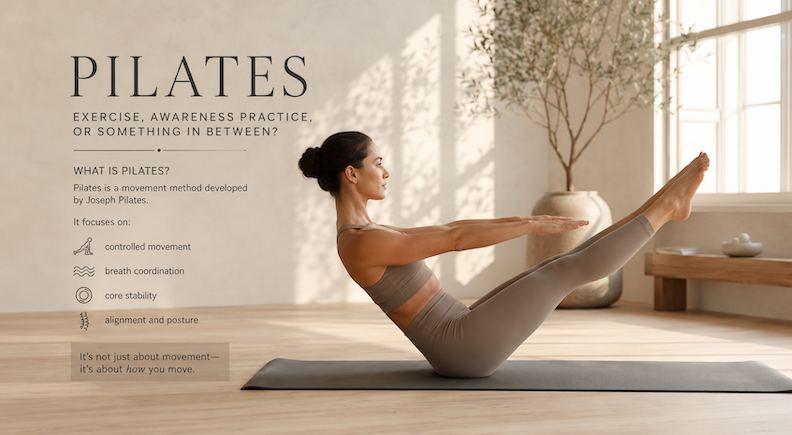
Exercise, Awareness Practice, or Something In Between?
What Is Pilates?
Pilates is a movement method developed by Joseph Pilates, built on the idea that physical health and mental awareness are deeply interconnected. At its core, Pilates focuses on controlled movement, breath coordination, core stability, and alignment and posture. But to define it purely as exercise would be to miss something essential. Pilates sits in a unique space—bridging strength and softness, effort and ease, discipline and awareness.
It is not just about movement—it is about how you move.
Unlike conventional workouts that often prioritize intensity, repetition, or calorie burn, Pilates invites a different kind of attention. Each movement is deliberate. Each breath has purpose. Each transition matters just as much as the exercise itself. This approach transforms what might seem like simple physical activity into a refined practice of embodiment.
Pilates teaches you to slow down enough to notice. Notice how your spine moves. Notice where you hold tension. Notice how your breath either supports or disrupts your movement. In doing so, it becomes more than a workout—it becomes a practice of awareness.
Foldable Pilates Reformer
All-in-One Home Pilates Studio. Dual Resistance System. Convenient Folding & Storage:

Exercise: The Physical Foundation
There is no denying that Pilates is an effective form of exercise. It strengthens the deep stabilizing muscles of the body, particularly those surrounding the core. These muscles—often underused in everyday life—play a critical role in supporting the spine, improving posture, and enhancing overall movement efficiency.
Through consistent practice, Pilates can increase flexibility, build balanced strength, and improve coordination. It works the body in an integrated way rather than isolating muscle groups, which leads to more functional, sustainable strength. This is why many people turn to Pilates not just for fitness, but for rehabilitation and injury prevention.
However, what makes Pilates distinct is not just what it does for the body, but how it achieves those results. The emphasis is not on pushing harder, but on refining movement. Precision takes precedence over speed. Quality overrides quantity.
Awareness Practice: The Subtle Layer
Beyond its physical benefits, Pilates cultivates a heightened sense of body awareness. This is where it begins to overlap with mindfulness practices. The breath becomes a guide, anchoring attention and supporting movement. Alignment becomes a form of listening—responding to the body’s natural structure rather than forcing it into position.
In a world that often encourages disconnection from the body, Pilates offers a way back. It asks you to inhabit your movements fully, to be present within your own physical experience. This presence has a ripple effect. As awareness deepens in the body, it often extends into daily life—how you sit, stand, walk, and even how you respond to stress.
This is why many practitioners describe Pilates as meditative, even if it does not resemble traditional meditation. The mind is engaged, focused, and quieted through intentional movement. There is a rhythm to it—a flow that brings you into the present moment without force.
Something In Between: Where Pilates Truly Lives
To frame Pilates as either exercise or awareness practice is to create a false distinction. Its true power lies in the integration of both. It strengthens the body while refining perception. It builds resilience while encouraging sensitivity. It challenges you physically while grounding you mentally.
This “in-between” space is where transformation happens. Not through extremes, but through consistency and attention. Pilates does not demand that you disconnect from effort, nor does it ask you to chase exhaustion. Instead, it invites you into a more intelligent relationship with your body.
Here, movement becomes a dialogue rather than a command. You are not forcing your body to perform—you are learning how to support it, align it, and move with it.
A Practice Rooted in Intention
One of the defining characteristics of Pilates is intention. Every exercise has a purpose. Every cue is meant to bring you closer to efficient, supported movement. This intentionality is what elevates Pilates from routine exercise to a practice.
When you approach Pilates with awareness, even the simplest movement can become profound. A small shift in alignment can change how a muscle engages. A deeper breath can transform the quality of a movement. These subtle changes accumulate over time, leading to lasting improvements not just in strength, but in how you inhabit your body.
About Us: Our Perspective on Pilates
At Still Alchemy, Pilates is not viewed as a trend or a quick fix. It is approached as a practice of refinement—one that honors both the physical and the internal experience. We believe that movement should not only strengthen the body but also deepen awareness and connection.
Our approach to Pilates is rooted in presence. We guide movement with intention, encouraging a pace that allows you to feel rather than rush. This creates space for real change—not just in how your body looks, but in how it functions and feels.
We see Pilates as a bridge. A bridge between effort and ease. Between structure and fluidity. Between the external form and the internal experience. This perspective shapes how we teach, how we practice, and how we invite others into movement.
Rather than separating exercise from awareness, we integrate them. Because true strength is not just physical—it is informed, supported, and conscious.
Pilates resists simple categorization. It is exercise, yes—but it is also a practice of awareness. It exists in the space between doing and sensing, effort and attention. And that is precisely what makes it so effective.
In a culture that often values extremes, Pilates offers something quieter, but no less powerful. It teaches that strength does not have to be forceful. That movement can be both precise and fluid. That awareness is not separate from physical practice, but essential to it.
Ultimately, Pilates is not just about how you move during a session. It is about how that movement changes the way you live in your body.
And that is where its true value lies.
You must be logged in to post a comment.