
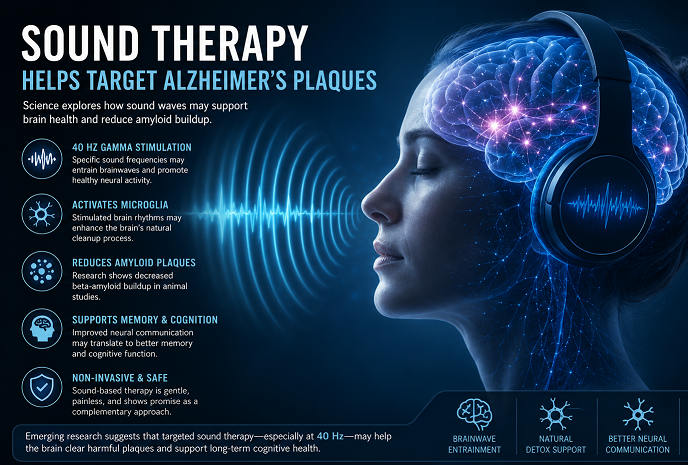
Can Acoustic Stimulation Help Target Brain Plaques?
Alzheimer’s disease remains one of the most complex and challenging neurodegenerative disorders facing modern medicine. Characterized by progressive memory loss, cognitive decline, and behavioral changes, it affects millions worldwide and places immense emotional and economic strain on families and healthcare systems.
At the biological level, Alzheimer’s is strongly associated with the buildup of beta-amyloid plaques and tau protein tangles in the brain. These abnormal accumulations disrupt communication between neurons, trigger inflammation, and ultimately lead to cell death.
While pharmaceutical approaches have attempted to slow or modify disease progression, growing attention is being directed toward non-invasive interventions—including a surprising candidate: sound therapy.
Emerging research suggests that specific sound frequencies, particularly when delivered in structured and rhythmic ways, may influence brain activity, potentially helping to reduce amyloid plaque accumulation and improve cognitive function. While still in early stages, this field sits at the intersection of neuroscience, acoustics, and therapeutic innovation.
This article explores how sound therapy works, what current research reveals about its potential role in Alzheimer’s disease, and what this could mean for the future of brain health.
Understanding Alzheimer’s Disease at the Neurological Level
To understand how sound might influence Alzheimer’s, it’s important to first examine what happens in the brain.
Two hallmark features define Alzheimer’s pathology:
- Beta-amyloid plaques: Sticky protein fragments that accumulate between neurons, interfering with communication.
- Tau tangles: Twisted fibers inside neurons that disrupt internal transport systems.
Together, these abnormalities contribute to:
- Synaptic dysfunction
- Neuroinflammation
- Reduced neural plasticity
- Progressive neuronal loss
One key factor gaining attention in recent years is the disruption of brain rhythms, particularly in the gamma frequency range (~30–100 Hz).
Gamma oscillations are associated with:
- Memory processing
- Attention
- Sensory perception
- Neural synchronization
In Alzheimer’s patients, gamma activity is often reduced or disorganized, suggesting that restoring these rhythms could be therapeutically relevant.
The Role of Brainwave Entrainment
Sound therapy operates, in part, through a principle known as brainwave entrainment.
This occurs when external rhythmic stimuli—such as sound pulses or tones—encourage the brain to synchronize its electrical activity with those frequencies.
For example:
- A repetitive auditory stimulus at 40 Hz may encourage the brain to generate gamma-frequency activity.
- This synchronization can influence neural networks, potentially enhancing communication and coordination across brain regions.
This concept has been studied in contexts such as meditation, sleep regulation, and stress reduction. However, its application to neurodegenerative disease represents a newer and rapidly evolving area of research.
The 40 Hz Breakthrough: Why This Frequency Matters
One of the most significant developments in this field involves stimulation at 40 Hz, a frequency within the gamma range.
Preclinical studies have shown that exposing the brain to 40 Hz stimulation—through sound, light, or a combination—can lead to measurable changes, including:
- Reduced beta-amyloid levels
- Activation of immune cells in the brain (microglia)
- Improved neural connectivity
- Enhanced cognitive performance in animal models
How It Works
The proposed mechanism involves entraining gamma oscillations, which in turn:
- Activate microglia
These are the brain’s immune cells responsible for clearing debris, including amyloid plaques. - Enhance waste clearance systems
Rhythmic activity may improve the function of glymphatic pathways, which remove toxins from brain tissue. - Improve neural communication
Synchronization across brain regions may support memory and cognition.
This suggests that sound is not merely a passive sensory input—it can actively shape brain function at a systems level.
Evidence from Animal Studies
Research using animal models has provided some of the most compelling early evidence.
In controlled experiments:
- Mice exposed to 40 Hz auditory stimulation showed significant reductions in amyloid plaque accumulation.
- These effects were particularly pronounced in regions associated with memory, such as the hippocampus.
- Improvements in learning and memory tasks were also observed.
More recent studies extended this work to non-human primates, offering a closer approximation to human brain complexity.
In these cases:
- Repeated sound stimulation sessions appeared to influence brain activity patterns.
- Preliminary findings suggested potential reductions in plaque burden and improved neural coordination.
While these results are promising, it is essential to recognize that animal models do not fully replicate human Alzheimer’s disease. Translation to human treatment remains a critical step.
Human Research: Early but Encouraging
Human studies on sound-based interventions for Alzheimer’s are still limited, but early findings are encouraging.
Some clinical investigations have explored:
- Combined light and sound stimulation at 40 Hz
- Daily sessions over extended periods (weeks to months)
- Cognitive and neurological outcomes
Reported effects include:
- Improved memory performance in some participants
- Increased gamma activity in brain recordings
- Enhanced functional connectivity between brain regions
Importantly, these interventions are non-invasive and generally well-tolerated, making them attractive as potential adjunct therapies.
However, results are not yet consistent across all studies, and larger trials are needed to confirm efficacy.
Sound Therapy Beyond Gamma Stimulation
While much attention is focused on 40 Hz stimulation, sound therapy encompasses a broader range of approaches.
Sound Baths and Immersive Audio Experiences
Sound baths typically involve:
- Singing bowls
- Gongs
- Tuning forks
- Ambient tonal instruments
Participants are immersed in layered sound frequencies designed to promote relaxation and altered states of awareness.
Although these practices are not specifically targeted at Alzheimer’s pathology, they may provide indirect benefits:
- Reduced stress and cortisol levels
- Improved sleep quality
- Enhanced emotional regulation
Given that stress and poor sleep are risk factors for cognitive decline, these effects may support overall brain health.
Sound as Meditation and Neural Regulation
Sound has long been used as a tool for meditation across cultures.
Repetitive auditory patterns can:
- Calm the nervous system
- Shift brainwave states (e.g., from beta to alpha or theta)
- Improve focus and emotional balance
From a neuroscience perspective, this may involve:
- Modulation of the default mode network (DMN)
- Increased parasympathetic (rest-and-digest) activity
- Reduced neural noise and improved signal clarity
While distinct from targeted gamma stimulation, these effects contribute to a broader understanding of how sound influences the brain.
The Immune Connection: Microglia Activation
One of the most intriguing aspects of sound-based Alzheimer’s research is its impact on microglia.
Microglia act as the brain’s cleanup crew, identifying and removing damaged cells and toxic proteins.
In Alzheimer’s disease:
- Microglia often become dysfunctional
- They may fail to clear amyloid effectively
- Chronic activation can lead to inflammation
Gamma-frequency stimulation appears to re-engage microglial activity in a beneficial way, enhancing their ability to clear plaques without triggering excessive inflammation.
This represents a potential shift in how researchers approach neurodegenerative disease—not just targeting plaques directly, but modulating the brain’s own defense systems.
Multisensory Stimulation: Light and Sound Together
Some of the most promising results come from combining auditory and visual stimulation.
In these protocols:
- Light flickers at 40 Hz
- Sound pulses at the same frequency
- The brain receives synchronized multisensory input
This approach may amplify effects by:
- Engaging multiple neural pathways simultaneously
- Increasing the strength of entrainment
- Enhancing overall brain coherence
Preliminary findings suggest that combined stimulation may produce greater reductions in amyloid levels than either modality alone.
Limitations and Scientific Caution
Despite growing interest, it is critical to approach this field with scientific rigor.
Key limitations include:
- Small sample sizes in human studies
- Short study durations
- Variability in protocols and methodologies
- Lack of long-term outcome data
Additionally:
- Alzheimer’s disease is multifactorial, involving genetics, lifestyle, and environmental factors
- No single intervention is likely to serve as a standalone cure
Sound therapy should therefore be viewed as a complementary approach, not a replacement for established medical care.
Ethical and Practical Considerations
As interest in sound-based interventions grows, several considerations emerge:
Accessibility
Sound therapy is relatively low-cost and scalable compared to pharmaceutical treatments.
Safety
Non-invasive stimulation carries minimal risk when properly administered.
Standardization
Clear protocols are needed to ensure consistency across applications.
Misinterpretation
It is important to avoid overstating claims or presenting early research as definitive proof.
Maintaining credibility requires careful communication of both potential and limitations.
Future Directions in Research
The next phase of research will likely focus on:
- Large-scale clinical trials
- Long-term effects of sustained stimulation
- Optimization of frequency, duration, and delivery methods
- Personalized approaches based on individual brain profiles
Technological advances may also play a role, including:
- Wearable neurostimulation devices
- AI-driven frequency modulation
- Home-based therapeutic systems
These developments could make sound therapy a practical component of everyday brain health strategies.
Integrating Sound Therapy into Holistic Brain Health
While targeted gamma stimulation represents a cutting-edge application, sound therapy fits within a broader framework of brain health.
Complementary strategies include:
- Regular physical activity
- Cognitive stimulation
- Sleep optimization
- Nutrition and metabolic health
- Stress management
Sound-based practices may support these areas by:
- Enhancing relaxation
- Improving sleep cycles
- Supporting emotional well-being
In this way, sound therapy can be seen as part of a multidimensional approach to cognitive resilience.
A Balanced Perspective
The idea that sound could influence brain pathology may seem unconventional, but it aligns with a growing understanding of the brain as a dynamic, rhythmic system.
Electrical activity, neural oscillations, and sensory input are deeply interconnected. By engaging these systems through carefully designed stimuli, it may be possible to influence processes once thought to be inaccessible without drugs or invasive procedures.
At the same time, the field is still evolving. Responsible interpretation of the evidence is essential to avoid misinformation and maintain trust.
Sound therapy represents a fascinating and promising frontier in Alzheimer’s research.
Through mechanisms such as brainwave entrainment, gamma oscillation enhancement, and microglial activation, targeted auditory stimulation may offer a novel way to address the underlying pathology of the disease.
While current evidence is still emerging, early findings suggest that sound—particularly at specific frequencies like 40 Hz—has the potential to influence brain function in meaningful ways.
As research progresses, sound therapy may become an important component of integrative approaches to neurodegenerative disease, complementing existing treatments and expanding the possibilities for non-invasive care.
For now, it stands as a compelling example of how ancient practices and modern neuroscience can converge to explore new pathways for healing and understanding the human brain.
You must be logged in to post a comment.