
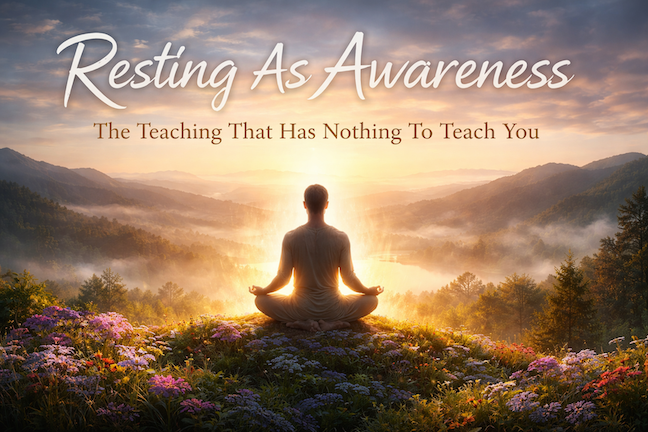
The Teaching That Has Nothing To Teach You
There’s a particular kind of spiritual exhaustion that comes from trying too hard. You’ve read the books, sat in the circles, followed the breath, watched the thoughts, labeled the emotions, and somewhere in all of that effortful seeking, you may have noticed something quietly absurd happening — the very act of trying to become more present keeps pulling you out of presence. The seeker and the sought keep missing each other, like two people circling the same building from opposite directions.
What we’re going to explore today cuts through all of that. Not with more complexity, not with a better system — but with something almost embarrassingly simple. And that simplicity is exactly what makes it so difficult.
The Watcher Is Still the Ego
Most spiritual traditions offer some version of the witness. Step back, they say. Observe your thoughts. Be the watcher behind the mind. And there’s genuine value in that practice — it loosens the grip of identification, creates some useful distance from the noise. But here’s what often goes unexamined: the watcher is still you doing something. The witness is still a role the ego is playing. A more refined role, a quieter role, perhaps a more spiritually impressive role — but a role nonetheless.
The ego can become very skilled at witnessing. It can get extraordinarily good at watching thoughts without reacting, at noting sensations with clinical detachment, at performing the posture of presence. And yet all of that refinement still lives within the territory of doing. You are still trying. You are still managing. You are still, underneath it all, a self who is working on becoming something.
As the teachers at Still Alchemy Sanctuary put it: “Resting as awareness isn’t a state of doing. It’s a state of being. You can’t really do resting as awareness.”
And that single insight, if you actually sit with it, dismantles an enormous amount of spiritual striving.
The Doer and Its Endless Questions
Inside most of us, there is a character we could call the Doer. The Doer is relentless. It wants to understand. It wants to perform correctly. It wants to optimize, refine, achieve, and master. Feed it a spiritual teaching and it will immediately ask: How do I do this? What’s the method? How do I know if I’m doing it right? How do I deepen it? How do I maintain it?
The Doer isn’t malicious. It’s just doing what it does — grasping for ground, for certainty, for a foothold. It genuinely believes that if it can just understand one more thing, figure out one more piece of the puzzle, it will finally be able to rest. It will finally arrive. What it doesn’t realize is that its very grasping is the obstacle.
The Doer has a close companion: the Understander. This is the part of the mind convinced that clarity of comprehension is the gateway to liberation. If you just conceptualize it correctly, arrange the ideas in the right order, finally crack the spiritual code — then you’ll get it. Then the peace will come. But the Understander feeds on concepts the way fire feeds on wood. Give it one insight and it immediately wants another. Understanding becomes its own addiction, and the peace it promises keeps retreating just one more breakthrough away.
Resting as awareness asks you to set down both of these characters — not forever, not dismissively, but for now. There is a time for doing. There is a time for understanding. This is neither of those times.
What Resting Actually Means
So what does it mean to rest as awareness? Not what do you do — we’ve established that’s the wrong frame entirely. What does it mean?
It means letting be.
Right now, in this moment, everything that is happening is happening. Your thoughts are moving or not moving. Sounds are arriving. The body is breathing. Sensations are present or absent. And underneath all of it — not separate from it, not watching it from a distance, but as it, through it, prior to it — awareness is already here. Not arriving. Not being cultivated. Already here, the way space is already here before anything is placed inside it.
Most of us don’t let very much be for very long. The mind reaches in almost immediately to organize, judge, narrate, fix, or flee. Letting be is not passive indifference — it is a full, open, non-grasping presence. It is what happens when you stop trying to make this moment into something other than what it is.
And resting as awareness is simply this: recognizing what is already the case, and not immediately running away from it into the next thought.
The Seductor Mind
Here is where it gets subtle, because the mind is extraordinarily clever at disguising doing as being.
You settle in. There’s a brief opening — a moment of genuine quiet where the efforting releases. And almost immediately, the mind sidles up. It doesn’t announce itself loudly. It’s far too sophisticated for that. Instead it whispers something seductive: “You know, if you just understood this one last thing, the resting would be so much easier. I promise. Just consider this one idea. Just answer this one question. Just resolve this one concern. And then — then you can truly rest.”
It’s an extraordinarily persuasive lure, because it sounds reasonable. It sounds helpful. It’s the Understander wearing the costume of wisdom, offering you one more conceptual snack before the silence. And if you follow it — which we all do, repeatedly — you find that the one last thing leads to another, and another, and suddenly you’re deep in the architecture of spiritual thinking again, having entirely lost the thread of what you were resting into.
The teaching here isn’t to fight this movement or to judge it. It’s simply to notice it. The mind will do what the mind does. The question is whether you take the bait.
Why Simplicity Is Harder Than Complexity
There’s a paradox worth naming directly: it is far easier to stay engaged with something complex than with something simple.
Give someone an elaborate, intricate spiritual framework — one with layers of metaphysics, rich terminology, and nested hierarchies of understanding — and they may study it with passionate consistency for months or years. The complexity itself is enlivening to the egoic mind. There’s so much to process. So much to master. So much to discuss.
Hand someone something genuinely simple — rest as awareness — and the egoic mind almost immediately grows restless. There’s nothing to do with it. There’s no ladder to climb. No certification to earn. No one to become. And the mind, finding no purchase, no project, no upgrade available, starts to feel a low-grade anxiety. It begins to generate questions and complications, not because the teaching is unclear, but because the mind cannot tolerate having nothing to manage.
This is why the simplest teachings are often the hardest to practice with any consistency. Not hard because they’re demanding, but hard because they give the ego nothing to hold onto — and the ego interprets that as a kind of threat.
You Are Not Someone Resting Into Awareness
What happens when resting begins to deepen — when it stops being an occasional moment of relief and starts becoming more familiar, more natural?
Something begins to shift in the underlying assumption.
At first, it feels like you — a person, a self, a seeker — are resting into awareness, as though awareness is a location or a state that you are entering from the outside. There’s still a subtle subject-object relationship: you over here, awareness over there, and the practice is the bridge between them.
But at some point, something dawns that can’t quite be forced or manufactured. The bridge dissolves. Not because you were practicing so hard, but almost in spite of all the practicing. It becomes apparent that awareness isn’t somewhere you go. Awareness is what you already are, at a level more fundamental than any story you’ve ever told about yourself.
All those years of self-concept — who you are, what you’re like, what you’ve been through, what you want — all of it was floating inside awareness, the way clouds float in sky. The clouds are real. But you are not the clouds. You are not even the one watching the clouds. You are closer to the sky itself.
The Invitation
None of this needs to be complicated. The invitation is actually as bare as it gets.
Right now, before the next thought, before the question about whether you’re doing this right, before the impulse to take notes or to understand or to improve — awareness is here. You don’t have to create it. You don’t have to deserve it. You don’t have to do anything at all to access what is already and completely present.
The spiritual path, in its deepest expression, is not a project of self-improvement. It is a relaxation into what has never not been here. It is the recognition — not as a concept, but as a direct felt knowing — that what you are seeking is precisely what is doing the seeking.
Rest. Not as a technique. Not as a practice session. Not as a goal with measurable outcomes.
Just rest.
That’s it. That’s the whole thing.
You must be logged in to post a comment.