
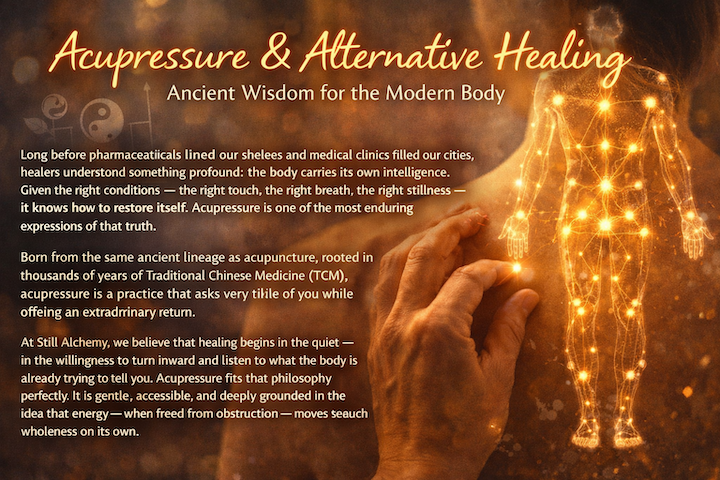
Ancient Wisdom for the Modern Body
Long before pharmaceuticals lined our shelves and medical clinics filled our cities, healers understood something profound: the body carries its own intelligence. Given the right conditions — the right touch, the right breath, the right stillness — it knows how to restore itself. Acupressure is one of the most enduring expressions of that truth. Born from the same ancient lineage as acupuncture, rooted in thousands of years of Traditional Chinese Medicine (TCM), acupressure is a practice that asks very little of you while offering an extraordinary return.
At Still Alchemy, we believe that healing begins in the quiet — in the willingness to turn inward and listen to what the body is already trying to tell you. Acupressure fits that philosophy perfectly. It is gentle, accessible, and deeply grounded in the idea that energy — when freed from obstruction — moves toward wholeness on its own.
What Is Acupressure?
Acupressure is a form of touch-based therapy rooted in Traditional Chinese Medicine. It operates on the premise that the human body contains a network of invisible energy pathways called meridians, through which a vital life force known as Qi (pronounced “chee”) flows. When Qi moves freely and evenly through these meridians, we experience physical health, emotional balance, and mental clarity. When it becomes stagnant, blocked, or disrupted — through stress, illness, poor posture, unresolved emotions, or trauma — symptoms begin to arise.
The practice involves applying firm, focused pressure to specific anatomical points along these meridian lines. These points, often called acupoints or pressure points, are the same locations targeted in acupuncture, but instead of needles, acupressure relies on the sustained pressure of fingers, thumbs, knuckles, or specialized tools. The result is a softening of tension, a stimulation of circulation, and a gradual return of energetic flow.
TCM identifies over 350 acupoints distributed across 12 primary meridians and two central channels — the Governing Vessel and the Conception Vessel. Each meridian is associated with a specific organ system, and each acupoint has a distinct therapeutic function. Some points calm the nervous system. Others support digestion, relieve pain, improve sleep, or strengthen immunity.
The Science Behind the Healing
Skeptics sometimes question whether energy pathways and Qi have any basis in measurable science. What research increasingly supports, however, is that the outcomes of acupressure are real and reproducible — even if the mechanisms are still being studied.
A growing body of clinical evidence suggests that acupressure stimulates the release of endorphins and other neurochemicals that naturally reduce pain and promote a sense of wellbeing. It activates the parasympathetic nervous system — the branch responsible for rest, digestion, and repair — effectively pulling the body out of the chronic stress response that so many people live in today. Studies have documented acupressure’s effectiveness in reducing nausea, including chemotherapy-induced nausea and morning sickness during pregnancy. Research has also shown measurable benefits for chronic lower back pain, menstrual pain, anxiety, insomnia, and headaches.
One particularly well-researched acupoint is Pericardium 6 (P6), located on the inner wrist. It has been studied extensively for its anti-nausea effects and is the basis for acupressure wristbands used by travelers and cancer patients alike. Another heavily studied point is Large Intestine 4 (LI4), found in the webbing between the thumb and index finger, which has demonstrated effectiveness for headache relief and labor pain management.
Key Acupressure Points and Their Benefits
Understanding a handful of core acupoints can give you immediate tools for self-care between healing sessions. Here are some of the most widely used points and what they address:
Stomach 36 (ST36) — Located four finger-widths below the kneecap and one finger-width lateral to the shinbone, this is one of the most important points in all of TCM. It is used to boost energy, strengthen immunity, improve digestion, and combat fatigue.
Governing Vessel 20 (GV20) — Found at the crown of the head, this point is used to calm the mind, lift the spirit, and relieve tension headaches. It is often engaged during meditation and energy healing practices.
Heart 7 (HT7) — Located at the wrist crease on the ulnar side, this point is deeply associated with the heart meridian and is commonly used for anxiety, insomnia, emotional distress, and palpitations.
Kidney 1 (KD1) — Found at the bottom of the foot in the upper third of the sole, this grounding point is used to calm fear, reduce dizziness, and anchor scattered energy.
Bladder 10 (BL10) — Located at the back of the neck near the base of the skull, this point relieves mental exhaustion, neck stiffness, and stress held in the upper body.
Spleen 6 (SP6) — Found three finger-widths above the inner ankle, this powerful convergence point works across three meridians simultaneously and is used for hormonal balance, digestion, and sleep support. Note: this point should be avoided during pregnancy.
Acupressure and the Nervous System
One of the most transformative aspects of acupressure — particularly when practiced in a mindful, intentional environment — is its direct effect on the autonomic nervous system. Most people today spend a significant portion of their lives in sympathetic dominance, more commonly known as the fight-or-flight response. Elevated cortisol, shallow breathing, disrupted sleep, digestive problems, and chronic tension are all hallmarks of this state.
Acupressure, when applied with slow, deliberate pressure and paired with conscious breathing, acts as a direct signal to the nervous system: you are safe. It is time to soften. The vagus nerve — a long cranial nerve that runs from the brainstem through the heart and into the digestive organs — plays a key role here. Stimulating certain acupoints appears to influence vagal tone, improving the body’s capacity to regulate itself and recover from stress.
This is why acupressure integrates so naturally with other nervous system practices like breathwork, meditation, yoga, and sound healing. Each of these modalities speaks to the same fundamental truth: the healing the body needs is already available. It simply needs space to emerge.
Acupressure Within the Broader World of Alternative Healing
Acupressure does not exist in isolation. It is one thread in a rich tapestry of alternative and complementary healing modalities that share a common foundation — the recognition that human beings are more than physical bodies, and that true wellness must address the energetic, emotional, and spiritual dimensions of life alongside the physical.
Reflexology is closely related to acupressure and involves applying pressure to specific zones of the feet, hands, and ears that correspond to different organs and systems of the body. While it draws from different traditional roots, the underlying philosophy — that the body is a map and that targeted pressure can affect distant systems — is deeply aligned.
Shiatsu is a Japanese form of bodywork that translates literally to “finger pressure.” It applies acupressure principles through a full-body treatment format, using thumbs, palms, elbows, and sometimes knees to work along meridian lines. Shiatsu is typically performed on a floor mat with the recipient fully clothed and is known for producing profound relaxation.
Reiki and energy healing modalities operate on the same meridian-based and biofield principles, though they often involve light touch or no touch at all, focusing on directing healing intention and energy toward the recipient.
Sound healing — a core offering at Still Alchemy — shares an elegant synergy with acupressure. Research and tradition both suggest that sound vibration, particularly from crystal singing bowls and gongs, can penetrate the tissues of the body and promote energetic release in ways that parallel what skilled acupressure achieves through touch. When these practices are experienced together or in close sequence, the cumulative effect on the nervous system and the energetic body can be profound.
How to Practice Acupressure at Home
One of acupressure’s greatest gifts is that it requires no equipment and no special setting. All it asks for is presence and a willingness to listen.
To begin a simple self-acupressure practice, find a quiet, comfortable position either seated or lying down. Take several slow, deep breaths to settle the nervous system. Identify the point you want to work with — use a reliable reference guide or practitioner recommendation to locate it accurately. Apply firm but gentle pressure using your thumb or index finger. Hold the point for 30 seconds to 3 minutes, breathing slowly and deeply throughout. You may feel a dull ache, warmth, tingling, or a sense of release. These sensations are normal and typically indicate that the point is active. Release gradually and take a few breaths before moving to the next point.
Consistency matters more than duration. A daily 10-minute self-care practice with two or three targeted points will yield far more benefit over time than an occasional hour-long session.
Still Alchemy and the Path of Alternative Healing
At Still Alchemy, we see acupressure not as a standalone technique but as part of a living, breathing approach to whole-person wellness. Our sanctuary in Los Angeles was built on the conviction that beneath the noise of modern life, beneath the fatigue and the tension and the disconnection, every person carries an inherent wholeness that is never truly lost — only temporarily obscured.
We bring together sound healing, guided meditation, yoga, and art and creative healing because we know that the path back to yourself rarely runs in a straight line. Sometimes it opens through music. Sometimes through movement. Sometimes through the quiet intelligence of a held point on the wrist or the sole of the foot. What matters is that you are given the space, the safety, and the support to find your own way.
Acupressure and the broader world of alternative healing are not trends or replacements for medical care. They are companions to it — ancient technologies of self-regulation and restoration that have served human beings for millennia and continue to be validated by emerging research. They ask you to participate in your own healing. They ask you to slow down, to pay attention, and to trust that your body — given what it needs — is capable of extraordinary things.
That is the alchemy we practice here. Not magic. Not mystery for its own sake. But the quiet, consistent, transformative work of returning to yourself.
You are already whole. We are simply here to help you remember.
Explore Healing at Still Alchemy
If you feel called to explore acupressure, energy healing, or any of the holistic modalities we offer, we invite you to reach out. Whether you begin with a sound bath, a yoga session, or a conversation, every step toward stillness is a step worth taking.
Visit us at stillalchemy.com to explore our offerings and book your first session.
You must be logged in to post a comment.