
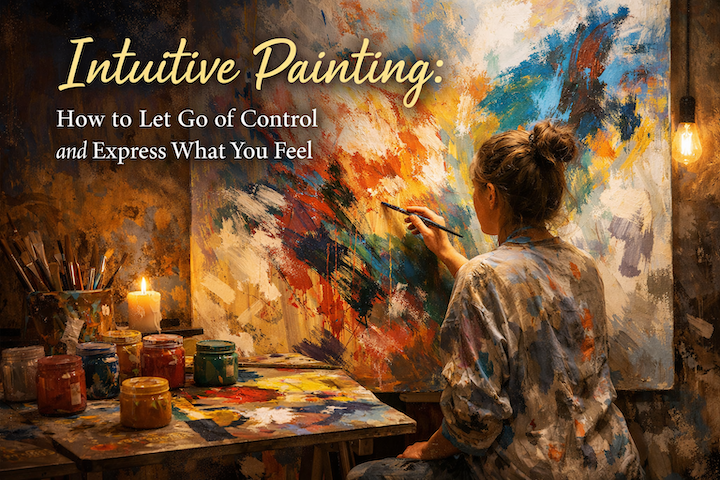
How to Let Go of Control and Express What You Feel
There is a version of creativity that exists before the rules. Before technique, before judgment, before the voice in your head says the brushstroke is wrong or the color is off or the whole thing looks like a mess. Intuitive painting lives in that space — the raw, honest, unfiltered place where your inner world meets a blank canvas with nothing in between.
It is not a new concept, but it is a deeply misunderstood one. Most people who hear the phrase “intuitive painting” assume it simply means painting freely or without much planning. But it goes far deeper than that. Intuitive painting is a practice, a philosophy, and for many who commit to it, a form of spiritual alchemy — a process of turning the lead of unexamined feeling into the gold of authentic expression.
What Intuitive Painting Actually Is
Intuitive painting is the practice of creating from an internal state rather than an external goal. It is not concerned with producing a beautiful result, mastering a technique, or communicating a concept to an audience. Instead, it is entirely focused on the process itself — what arises moment to moment as brush meets surface, as color meets color, and as the maker chooses to follow the pull of the work rather than the plan in their head.
Unlike conventional art instruction, which teaches you how to replicate a style or achieve a specific outcome, intuitive painting teaches you how to listen. It treats the canvas as a conversation and the painter as someone responding, not directing. Each layer of paint suggests the next. Each unexpected mark opens a new possibility. The painting evolves based on feeling, impulse, and inner prompting rather than a preconceived sketch or visual blueprint.
This approach is also distinct from art therapy, though the two share common ground. In art therapy, you are guided to examine what your artwork reveals and explore its psychological meaning. In intuitive painting, you are invited to stay out of analysis entirely. The practice asks you to trust that something valuable is happening even when your rational mind cannot explain it. Healing unfolds not because you decoded the symbols on the canvas, but because you showed up and allowed expression to move through you without interference.
The Inner Critic and the Art of Surrender
The single greatest obstacle in intuitive painting is not technique — it is the inner critic. That voice that evaluates every choice in real time, comparing your work to someone else’s, deciding that this shade is wrong, that mark is awkward, or that the whole piece is beyond saving.
The inner critic is a product of a culture that ties creative worth to aesthetic outcome. We are taught from early childhood that art is something you are either good at or not, something to be graded, displayed, or dismissed. Intuitive painting directly dismantles that conditioning. It asks you to place no value on whether the final piece is beautiful. It asks you to define success entirely by your willingness to keep going, to stay present, and to remain open to what wants to emerge.
This is why many practitioners describe intuitive painting as “the hard work miracle.” Letting go of control is genuinely difficult. It requires a kind of courage that does not come naturally to most adults. When you pick up the brush without a plan, you are walking into unknown territory with no map and no promised destination. That vulnerability is exactly the point. It is in that unguarded space that authentic expression becomes possible.
One of the most useful shifts you can make is moving from a results-based mindset to a curiosity-based one. Instead of asking “Is this good?” ask “What is this telling me?” Instead of trying to fix a passage that feels wrong, ask “What would happen if I painted over it with something completely unexpected?” This reorientation from judgment to inquiry is the doorway through which intuitive painting does its deepest work.
The Science and Spirituality Behind Letting Go
There is both a psychological and a spiritual dimension to what happens when you paint intuitively. From a psychological standpoint, expressive art practices have been shown to activate the parasympathetic nervous system, lower cortisol levels, and create measurable reductions in anxiety and emotional distress. When you engage in open-ended, process-based creativity, the brain enters a state similar to meditation — the default mode network becomes active, the prefrontal cortex relaxes its grip on control, and the deeper associative mind is given space to surface.
From a spiritual standpoint, intuitive painting sits at the intersection of stillness and expression. It is not passive — you are actively engaged — but the quality of engagement shifts from willful doing to receptive allowing. Many artists who work this way describe the experience as channeling, as though the painting is happening through them rather than by them. This is the alchemy at the heart of the practice: your attention, your presence, and your willingness to release control become the conditions in which something genuinely new and genuinely yours can come through.
The concept of beginner’s mind, drawn from Zen philosophy, is central here. Even if you have painted for decades, intuitive painting asks you to approach the canvas as though it is the first time — with no assumptions, no habitual moves, and no certainty about where things are going. It is in that beginner’s openness that the most surprising and revealing work tends to arise.
How to Begin: A Practical Guide to Your First Intuitive Painting Session
You do not need to be an artist to begin intuitive painting. You do not need expensive supplies, a studio, or any prior experience. What you need is a surface, some paint, a willingness to get messy, and the intention to follow feeling over judgment.
Start by setting the space. Dim the lights if you like. Put on music that matches the emotional state you want to explore — not music you are analyzing, but music that moves through you. Light a candle. Do whatever small ritual helps you signal to your mind that this time is different from ordinary doing. You are entering a space of listening.
Choose your colors by feel rather than logic. Do not think about whether they go together. Notice which ones draw you in, which ones feel charged, which ones you have been avoiding. Those are often exactly the ones to reach for first.
Make your first marks without deciding what they mean. Use whatever tool feels right — a wide brush, your hands, a sponge, a palette knife. Move from a physical place: let your arm swing, press into the surface, drag color across in broad gestures. This is not about finesse. It is about establishing contact between your inner state and the canvas.
Stand back frequently. Put the canvas on the wall or prop it up and take several steps back. Intuitive paintings speak more clearly from a distance. You will notice things that are alive, things that are calling for more, shapes that are beginning to emerge, areas that feel stuck or overworked. Let these observations guide you rather than a predetermined plan.
Work in layers. One of the most important principles of intuitive painting is that early layers are not mistakes — they are foundations. You are not trying to create a finished painting from the first mark. You are building a conversation across time, each layer responding to what came before. Acrylics are particularly forgiving here: they dry fast and paint over cleanly, which means you can always transform something that is not working into a new beginning.
Trust the ugly stage. Every intuitive painting goes through a point where it looks like nothing. Where the colors have gone muddy, the composition feels chaotic, and you have no idea how to move forward. This is not failure. This is the threshold. Stay with it. Make one more move, even if it feels random. Often, the most powerful passages of a painting come from decisions made precisely when the painter had stopped trying to make it look good and simply responded to what was there.
Working with Emotion on the Canvas
Intuitive painting is one of the most direct ways available to process and transform emotional experience. Grief, anger, joy, longing, confusion — all of these states have a visual language that your body knows even when your mind cannot find the words. When you allow yourself to paint from a feeling rather than about a feeling, something shifts. The emotion is no longer trapped in your chest or circling in your thoughts. It has somewhere to go.
You do not need to paint a literal representation of your emotional state. In fact, it is often more powerful not to. Let color carry the weight. Let the pressure of your brushstroke express what you cannot say. Let a shape appear without naming it. The canvas holds what words cannot, and in that holding, something releases.
This is the alchemy of the practice. Raw feeling enters the canvas and is transformed through the act of witnessing it. You become both the one who feels and the one who sees, and in that dual presence, a kind of integration happens. You are not escaping your inner world — you are walking all the way into it, and finding that it can be held.
Who Intuitive Painting Is For
Intuitive painting is not reserved for those who identify as artists. It is particularly valuable for people who were told they were not creative, who hold perfectionist tendencies, who are moving through grief or transition, who are seeking a non-verbal form of self-inquiry, or who simply feel disconnected from their own sense of aliveness. It is a practice for anyone who has ever silenced a creative impulse before it had a chance to breathe.
It is equally powerful for trained artists who have become rigid in their practice, overly focused on outcome, or creatively blocked. Coming to the canvas without an agenda can dissolve those patterns and restore access to a kind of creative vitality that technique alone cannot produce.
Still Alchemy and the Invitation to Create from Within
At Still Alchemy, we understand that creativity is not separate from healing — it is one of its most direct expressions. We believe in the wisdom that lives beneath the surface of the everyday mind, the knowing that does not speak in words but in impulse, in color, in the quiet insistence of something that wants to be made.
Intuitive painting aligns deeply with everything we hold at the core of this space: the value of stillness as a doorway, the power of inner alchemy to transform what feels stuck into something luminous, and the understanding that authentic expression — messy, layered, and alive — is one of the most sacred things a person can offer themselves. Whether you come to this practice as a seeker, a healer, or simply someone curious about what your inner world looks like when given a brush, you are welcome here. The canvas does not judge. Neither do we.
Intuitive painting will not always produce work you want to hang on a wall. But it will, without question, produce something far more valuable — a deeper relationship with your own interior life, a language for the things you feel but cannot yet say, and a practice of radical creative trust that extends far beyond the studio into every dimension of how you live.
The invitation is simple: pick up the brush, let go of the outcome, and see what is there when you stop trying to make something and simply allow something to move through you. That is where the real work begins. That is where the alchemy lives.
You must be logged in to post a comment.