
How Movement Helps You Process Emotions and Shift Energy
There are moments in life when everything feels frozen. You wake
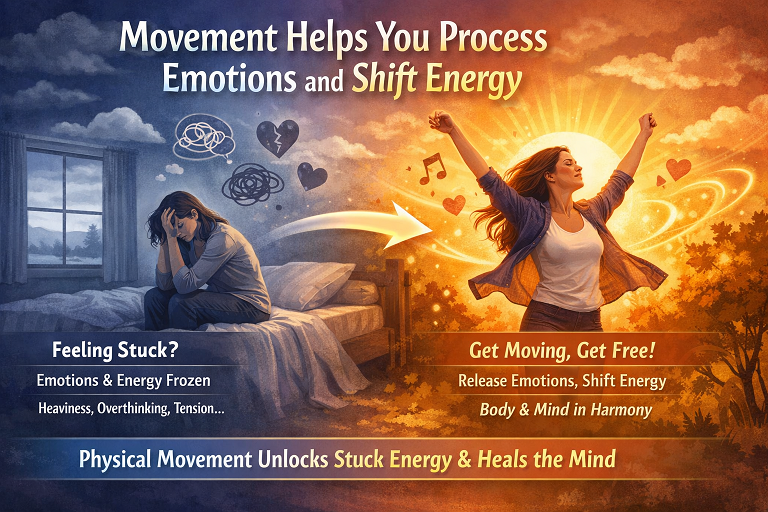
There are moments in life when everything feels frozen. You wake up carrying the same heaviness you went to sleep with. Your thoughts loop. Your chest feels tight. You know something needs to change, but you cannot find the door. This feeling of being stuck is not a personal failure — it is a signal from your body that energy has stopped moving, and that emotions are waiting to be processed rather than suppressed.
What most people do not realize is that the body and the mind are not separate systems. Emotions are not just mental experiences — they are deeply physical ones. And one of the most powerful, science-backed, and spiritually aligned ways to begin moving stuck energy is also one of the most accessible tools you have: physical movement.
What It Actually Means to Feel “Stuck”
Feeling stuck is more than a metaphor. When we experience stress, grief, anxiety, trauma, or prolonged emotional tension, the nervous system responds by activating its survival circuits — the fight, flight, or freeze response. In many cases, especially when we cannot fight or flee, the body goes into a kind of holding pattern. The stress hormones cortisol and adrenaline get released but never fully discharged. The muscles tighten. The breath becomes shallow. The energy that was meant to move through the body gets locked inside it.
This is why so many people describe emotional pain in physical terms: a weight on their chest, a knot in their stomach, tightness in their throat, tension in their shoulders. These are not coincidences. Somatic research — most notably the work of Dr. Bessel van der Kolk, author of The Body Keeps the Score — has established that unprocessed emotions are stored in the body’s tissues and nervous system, not just in the mind. Healing, therefore, cannot happen exclusively through thinking. It has to include the body.
The Science of Movement and Emotional Processing
When you move your body, a cascade of neurochemical events begins that directly impacts your emotional state. Exercise and intentional movement stimulate the release of endorphins, dopamine, serotonin, and norepinephrine — all neurotransmitters associated with mood regulation, motivation, and emotional resilience. But the relationship between movement and emotional processing goes even deeper than neurotransmitters.
Research in the field of somatic psychology shows that rhythmic, repetitive movement — such as walking, running, dancing, or even rocking — activates the parasympathetic nervous system, shifting the body out of the stress response and into a state of regulated calm. Studies published in journals such as Frontiers in Psychology have found that bilateral movements (movements that alternate between the left and right sides of the body) can reduce the emotional charge of distressing memories and thoughts. This is the same principle that underlies EMDR (Eye Movement Desensitization and Reprocessing), a trauma therapy that uses bilateral stimulation to help the brain process stuck experiences.
Movement also regulates the vagus nerve, which is the primary pathway of the parasympathetic nervous system and plays a central role in how we process and recover from emotional stress. Practices like yoga, tai chi, and breathwork-integrated movement have all been shown to improve vagal tone, which directly enhances our capacity to move through difficult emotions without becoming overwhelmed by them.
Why Emotions Need Movement to Complete Their Cycle
Authors Emily and Amelia Nagoski, in their book Burnout, introduced many readers to the concept of the “stress response cycle.” The idea is straightforward but profound: emotions are biological processes that have a beginning, a middle, and an end. However, in modern life, we often interrupt this cycle. We feel a big emotion, suppress it because we are at work or in public, and then never return to let it finish. Over time, these incomplete cycles accumulate in the body, contributing to burnout, chronic anxiety, and physical symptoms like fatigue, insomnia, and chronic pain.
The Nagoskis found that physical activity is one of the most effective ways to complete the stress response cycle. Even twenty to thirty minutes of vigorous movement signals to the nervous system that the “danger” has passed and that it is safe to return to baseline. You are essentially giving your body permission to finish what it started.
This is why you may have cried after a hard run, felt an unexpected wave of grief lift after a yoga class, or experienced clarity after a long walk in nature. The movement was not distracting you from your emotions — it was helping them move through you.
Types of Movement and What They Help Process
Not all movement works the same way for all emotions, and understanding the nuances can help you choose the right practice for what you are carrying.
High-intensity movement — such as sprinting, boxing, dancing with abandon, or any form of vigorous cardio — is particularly effective for processing anger, frustration, and anxiety. These emotions carry a physiological charge that needs to be discharged. When you let the body move at its full capacity, it metabolizes that charge and allows the emotion to complete its cycle.
Slow, intentional movement — such as yoga, qigong, tai chi, and stretching — works more deeply with grief, numbness, and emotional shutdown. These practices bring attention back into the body gently, reawakening sensation and allowing suppressed feelings to surface in a safe, controlled way. Hip openers in yoga, for instance, are widely noted by practitioners to release stored emotional tension, consistent with the research around the psoas muscle and its relationship to the fear response.
Walking in nature combines the bilateral, rhythmic nature of walking with the nervous-system-regulating effects of natural environments. Studies in environmental psychology have consistently shown that time in green spaces reduces cortisol levels and activates restorative mental states. When you walk through a park, along the ocean, or through a forest, you are simultaneously processing emotions and replenishing your energy reserves.
Dance and free movement are particularly powerful because they invite expression without the need for language. Emotions that cannot be articulated can be moved. Dance/movement therapy is a recognized clinical practice used with trauma survivors, people experiencing depression, and individuals working through grief, and it draws on the simple truth that the body has its own intelligence and its own language.
The Mind-Body-Spirit Connection: Beyond the Physical
Understanding stuck energy requires moving beyond the purely physical and honoring the energetic and spiritual dimensions of the body as well. In many ancient healing traditions — including Ayurveda, Traditional Chinese Medicine, and various Indigenous healing practices — the body is understood as a field of energy, not merely a machine made of tissue and bone. When emotions are suppressed or trauma is unresolved, this energy stagnates. The ancient Chinese concept of qi describes this life force as something that must flow freely through the body’s meridians for health and vitality to be maintained.
Movement practices like qigong and tai chi were designed specifically to cultivate and direct this energy, clearing blockages and restoring flow. In Ayurvedic tradition, movement is part of dinacharya — the daily routine that keeps the body’s doshas in balance and the mind clear. These traditions understood what modern neuroscience is now confirming: that the body, mind, and spirit are not separate systems, and that healing one requires addressing the others.
Practical Ways to Use Movement to Shift Your Energy Today
You do not need a gym membership, an hour of free time, or a choreographed routine to begin. The entry point is wherever you are right now.
Start with your breath and your body. Before you choose a movement, take three deep, conscious breaths and do a body scan. Notice where you feel tension, heaviness, or numbness. Let that guide you to a movement practice that meets your body where it is.
If you are feeling angry, anxious, or overwhelmed, go for a brisk walk or a run, put on music and dance hard in your kitchen, or do burpees, jump rope, or any movement that lets the body discharge its charge. If you are feeling sad, numb, or disconnected, choose slower movement. Gentle yoga, stretching, or a slow walk in nature can help you return to sensation and allow grief to surface gently. If you feel frozen or dissociated, start even smaller. Shake your hands. Bounce lightly on your feet. Sway from side to side. Micro-movements activate the nervous system and begin to thaw the freeze response. If you feel mentally cluttered or creatively blocked, try walking without a destination. Let your mind wander. Research from Stanford University found that walking increases creative output by an average of 81 percent, and it also naturally integrates unprocessed thoughts.
Make movement a ritual rather than a task. Put on a song that matches what you need to feel — or what you need to release — and give yourself full permission to move without judgment or choreography.
How Still Alchemy Supports Your Journey of Mind, Body, and Soul
Feeling stuck is one of the most human experiences there is. It is the pause before the shift, the stillness before the transformation. The body knows how to move through it — and movement is one of the most direct ways to help it do so. Whether you walk, run, dance, stretch, or simply shake your hands loose, you are participating in one of the oldest forms of healing there is. You are telling your body: it is safe to feel, it is safe to move, and it is safe to change.
The energy that feels frozen in you today is not permanent. It is waiting for motion.
You must be logged in to post a comment.