
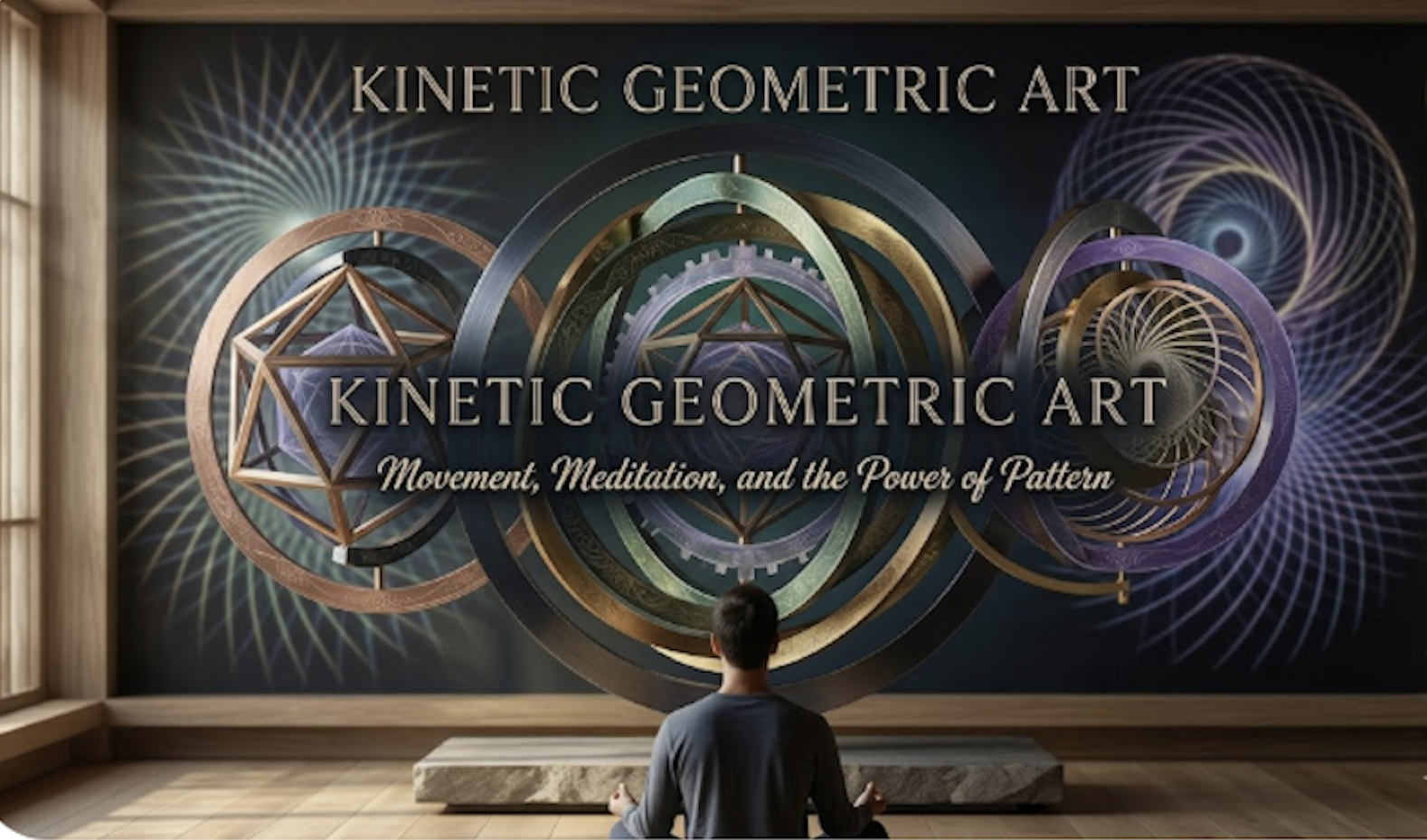
Movement, Meditation, and the Power of Pattern
Kinetic geometric art lives at the intersection of motion, mathematics, and mindful perception. It is not simply something to look at—it is something to experience. Through shifting forms, repeating structures, and rhythmic movement, this art form invites the viewer into a deeper state of awareness. For a brand rooted in intentional design and quiet transformation like Still Alchemy, kinetic geometric art reflects more than aesthetics—it embodies a philosophy of presence, flow, and inner alignment.
What Is Kinetic Geometric Art?
Kinetic geometric art is a specialized expression within kinetic art, a genre defined by movement or the illusion of movement as an essential component of the artwork. At its core, kinetic art involves motion—whether powered by wind, mechanical systems, or the viewer’s interaction—or visual patterns that create the sensation of motion . When combined with geometric abstraction, this movement becomes structured, intentional, and often deeply symbolic.
Geometric art relies on precise shapes, symmetry, and mathematical relationships. When these elements are activated through motion, the result is kinetic geometric art—patterns that shift, evolve, and transform over time. These pieces may physically move, like rotating sculptures, or they may appear to move through optical illusion, using repetition and contrast to create dynamic visual effects.
Unlike static artwork, kinetic geometric art unfolds. It exists not just in space, but in time.
Handcrafted Kinetic Wall Art with 10-Hour Motion, No Power Required
A handcrafted kinetic wall art piece designed to create continuous, mesmerizing movement for up to 10 hours without requiring electricity. Blending artistic craftsmanship with mechanical precision, it offers a calming, meditative visual experience powered entirely by internal motion rather than external energy sources.

Movement as a Language
Movement in kinetic geometric art is not random—it is a language. Each rotation, oscillation, or visual shift carries intention. Motion becomes a medium through which patterns reveal themselves gradually, often surprising the viewer.
Historically, kinetic art emerged in the early 20th century and gained prominence in the 1950s and 60s, influenced by advances in technology and a growing fascination with perception and dynamism . Artists began exploring how motion could transform static forms into living systems, where geometry became fluid rather than fixed.
In kinetic geometric art, movement often follows mathematical principles—spirals, waves, grids, and sequences. These patterns mirror those found in nature, from the unfolding of a fern to the orbit of planets. The result is a visual experience that feels both structured and organic.
Meditation Through Motion
One of the most compelling aspects of kinetic geometric art is its meditative quality. Repetition, symmetry, and rhythm naturally draw the mind into a focused state. As patterns move and evolve, the viewer’s attention softens, becoming absorbed in the flow.
This is where art transitions into experience.
The slow turning of a geometric form or the pulsing shift of an optical pattern can quiet mental noise. It encourages stillness without forcing it. Much like watching waves or a flickering flame, kinetic geometric art creates a space where time feels suspended.
This meditative effect is not accidental. The human brain is wired to recognize patterns. When those patterns move in predictable yet evolving ways, they engage both curiosity and calm. The viewer becomes part of the artwork—not by touching it, but by perceiving it.
The Power of Pattern
Pattern is the foundation of geometric art, and in kinetic form, it becomes even more powerful. Repetition creates rhythm. Symmetry creates balance. Variation within repetition creates intrigue.
Kinetic geometric art often draws from universal mathematical principles—the Fibonacci sequence, sacred geometry, and harmonic ratios. These patterns are not only visually pleasing; they resonate on a deeper level because they reflect the underlying order of the natural world.
When these patterns are set in motion, they reveal layers that cannot be seen in stillness. A static geometric design may appear simple, but when it moves, hidden relationships emerge. Lines align, shapes morph, and new forms appear and disappear.
This dynamic quality transforms pattern into a living system.
Physical vs. Optical Movement
Kinetic geometric art exists across a spectrum of motion. Some works rely on physical movement—sculptures powered by motors, wind, or human interaction. These pieces change form in real time, offering a tangible sense of transformation.
Other works use optical movement. Through carefully arranged lines, colors, and shapes, they create the illusion of motion on a flat surface. The viewer’s perception completes the artwork, making movement a collaborative experience between the piece and the observer.
Both approaches share a common goal: to challenge the idea that art is fixed. Instead, they present art as something fluid, responsive, and alive.
A Sensory Experience
Kinetic geometric art often engages more than just sight. Many works incorporate light, shadow, and even sound, creating immersive environments. As elements move, they cast shifting reflections and patterns, transforming the surrounding space.
This multi-sensory aspect deepens the experience. The artwork is no longer an object—it becomes an atmosphere.
For a viewer, this can feel almost transformative. The boundaries between self and space blur, replaced by a sense of connection to movement and pattern.
About Us: Still Alchemy and the Art of Presence
At Still Alchemy, the philosophy aligns naturally with the essence of kinetic geometric art. The name itself suggests a paradox—stillness and transformation existing together. This mirrors the experience of kinetic art, where movement creates stillness within the observer.
The intention behind Still Alchemy is not just to create or curate objects, but to offer moments of awareness. Kinetic geometric art embodies this intention perfectly. It invites pause. It encourages observation. It transforms simple forms into meaningful experiences.
By embracing the interplay of movement and geometry, Still Alchemy connects design with mindfulness. Each pattern, each motion, becomes a reminder to slow down and notice. In a world that often feels chaotic, this kind of art offers clarity through structure and calm through repetition.
This is not decoration—it is a practice.
Why Kinetic Geometric Art Matters
In today’s fast-paced digital environment, attention is fragmented. Kinetic geometric art offers a counterbalance. It captures attention not through noise, but through rhythm and subtle transformation.
It reminds us that beauty can unfold slowly. That complexity can arise from simple rules. That movement, when intentional, can bring stillness.
More than anything, it reconnects us with the fundamental patterns that shape our world. Whether through physical motion or visual illusion, it reveals that change is constant—and that within that change, there is order.
Kinetic geometric art is more than a visual style—it is an experience rooted in motion, pattern, and perception. By combining the precision of geometry with the fluidity of movement, it creates artworks that evolve over time and engage the viewer on a deeper level.
For Still Alchemy, this form of art aligns seamlessly with a philosophy of mindful design and intentional living. It transforms observation into meditation and pattern into presence.
In the end, kinetic geometric art does not just move—it moves us.
You must be logged in to post a comment.