
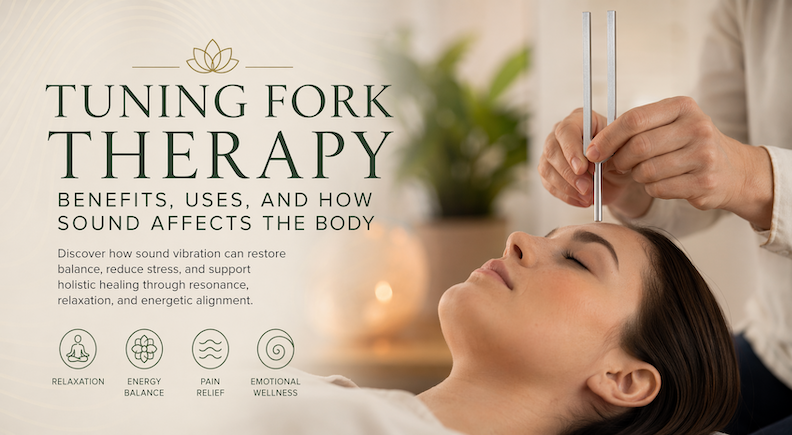
Benefits, Uses, and How Sound Affects the Body
Sound has always been a quiet force shaping human experience. Long before modern wellness practices, vibration, tone, and resonance were used to restore balance and deepen awareness. Today, tuning fork therapy brings that ancient understanding into a refined, intentional practice—one that aligns seamlessly with a holistic approach to healing and energetic harmony.
What Is a Tuning Fork?
A tuning fork is a precisely calibrated metal instrument that produces a specific frequency when struck. Traditionally used to tune musical instruments, tuning forks emit a pure tone that resonates at a consistent vibrational rate. In sound healing, these frequencies are applied to the body and the surrounding energy field to encourage balance, relaxation, and alignment.
Unlike ambient music or recorded sound, tuning forks deliver direct vibrational input. When placed near or on the body, their frequencies interact with tissues, bones, and the subtle energy system, offering a focused and intentional therapeutic effect.
Resonance Sound Healing Tuning Fork Set
This comprehensive sound therapy set features four precisely calibrated frequencies designed to support holistic well-being. By utilizing both weighted and unweighted forks, the kit offers a versatile approach to sound healing—from direct physical vibration for muscle tension to atmospheric tones for mental clarity. It includes an activator and a storage pouch, making it a portable solution for professional practitioners or personal home use.

Key Frequencies & Benefits:
- 128Hz & 136.1Hz (Weighted): Ideal for physical grounding, nervous system resets, and easing muscle tension through direct body contact.
- 256Hz & 384Hz (Unweighted): Perfect for clearing the energetic field, enhancing sleep quality, and promoting chakra balance.
- Stress & Anxiety Relief: Targeted tones help shift the body from a “fight or flight” state into a restorative, parasympathetic mode.
- Versatile Application: Designed for meditation, yoga, massage therapy, and general emotional regulation.
How Sound Affects the Body
The human body is not just physical—it is vibrational. Every organ, cell, and system operates at a frequency. When stress, trauma, or imbalance occurs, these natural rhythms can become disrupted. Sound therapy works by introducing stable, coherent frequencies that encourage the body to return to its natural state of harmony.
This process is often described as entrainment. The body begins to synchronize with the consistent tone of the tuning fork, gently shifting from dissonance to coherence. This can influence the nervous system, reduce stress responses, and promote a sense of calm presence.
Sound also travels efficiently through water, and since the body is largely composed of water, vibration moves deeply and effectively. This is why many people experience tuning fork therapy not just as something they hear, but something they feel—subtle yet profound.
The Benefits of Tuning Fork Therapy
Tuning fork therapy offers a range of benefits that extend across physical, emotional, and energetic layers.
One of the most immediate effects is deep relaxation. The steady tone helps calm the nervous system, reducing anxiety and mental overactivity. This creates space for the body to shift into a restorative state where healing processes can naturally occur.
It is also commonly used for pain relief. When applied to specific points on the body, tuning forks may help reduce tension, improve circulation, and ease discomfort. The vibration can stimulate muscles and tissues, encouraging release and improved flow.
On an emotional level, tuning fork therapy can help process stored stress and energetic blockages. Sound creates a gentle pathway for release, allowing emotions to surface and dissipate without force. This makes it a supportive practice for those seeking clarity, grounding, and emotional balance.
Energetically, tuning forks are often used to align chakras or clear the biofield. By introducing precise frequencies, practitioners aim to restore flow and coherence within the body’s energy system. While subtle, these shifts can lead to a greater sense of alignment and inner stability.
Common Uses in Practice
Tuning fork therapy is versatile and can be integrated into various wellness practices. It is often used in one-on-one sessions where forks are activated and placed near specific areas of the body, such as joints, meridian points, or energy centers.
In some approaches, weighted tuning forks are placed directly on the body to deliver vibration deeper into tissues. Unweighted forks are typically used in the surrounding energy field, influencing the subtle layers beyond the physical form.
This therapy is also incorporated into meditation and mindfulness practices. The clear tone of a tuning fork can serve as an anchor, helping individuals stay present and centered. It can mark the beginning or end of a session, creating a ritualistic and intentional space.
Some people use tuning forks in personal self-care routines, applying them to areas of tension or simply listening to their resonance to reset their mental state. The simplicity of the tool makes it accessible, while its depth of impact makes it powerful.
The Experience of a Session
A tuning fork therapy session is often quiet, minimal, and deeply intentional. There is no overwhelming stimulation—just the gentle presence of sound and vibration.
As the forks are activated, you may notice subtle sensations: a soft pulsing, a sense of warmth, or a shift in awareness. Over time, these sensations can deepen into a state of calm stillness. Many describe the experience as meditative, grounding, and restorative.
Each session is unique. The body responds differently depending on what it needs, and the frequencies act as a guide rather than a force. This allows the process to feel natural and supportive rather than intrusive.
How Tuning Fork Therapy Aligns With Holistic Wellness
Tuning fork therapy fits seamlessly into a broader holistic lifestyle. It does not seek to override the body, but to support its inherent intelligence. This aligns with the philosophy that healing is not something imposed from the outside, but something that emerges when the body is given the right conditions.
Sound becomes a bridge—connecting the physical and energetic, the tangible and the subtle. It invites awareness, presence, and a deeper connection to self.
Because it is non-invasive and gentle, tuning fork therapy can complement other practices such as breathwork, meditation, and bodywork. It enhances rather than replaces, creating a layered and integrated approach to wellness.
About Us and Our Approach to Sound Healing
At Still Alchemy, our approach to tuning fork therapy is rooted in intention, simplicity, and presence. We believe that true healing unfolds in stillness—when the body and mind are given space to recalibrate and return to balance.
Sound is one of the most refined tools we use to support this process. Tuning forks allow us to work with precision while maintaining a sense of calm and clarity. Each session is guided not just by technique, but by awareness—honoring the unique state of each individual.
We focus on creating an environment where you can slow down, reconnect, and experience subtle yet meaningful shifts. Rather than overwhelming the senses, our work emphasizes minimalism and depth, allowing the resonance of sound to speak for itself.
This philosophy reflects a broader commitment to conscious wellness. Every element is intentional, every moment grounded. Tuning fork therapy is not just a service—it is an invitation to experience balance in a way that feels natural and sustainable.
Why Sound Healing Continues to Resonate
In a fast-paced world filled with constant stimulation, the simplicity of sound offers something rare: stillness. Tuning fork therapy reminds us that healing does not always require complexity. Sometimes, it begins with a single tone—a vibration that gently guides the body back to itself.
As more people explore holistic practices, sound therapy continues to gain recognition for its subtle yet impactful effects. It speaks to something intuitive, something deeply human—the understanding that we are, at our core, vibrational beings.
Tuning forks provide a doorway into that awareness. Through their resonance, they help quiet the noise, restore balance, and create space for a more grounded and aligned experience of well-being.
You must be logged in to post a comment.