
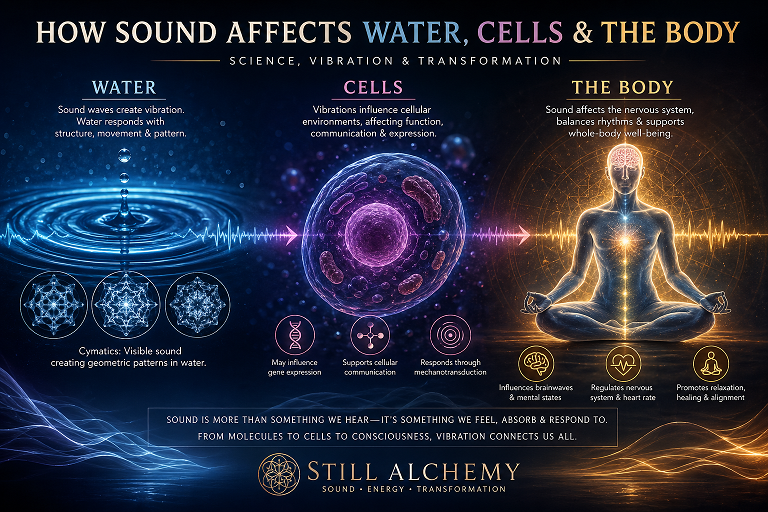
Bridging Physics, Biology & Experience
Sound is often thought of as something we hear—but at a deeper level, it is something we feel, absorb, and physically respond to. From the rippling surface of water to the microscopic activity inside human cells, sound operates as a mechanical force capable of influencing structure, rhythm, and function.
To truly understand sound healing—or even why music can calm, energize, or move us emotionally—we need to look at three interconnected layers: water, cells, and the human body as an integrated system. When these are viewed together, a compelling picture emerges: sound is not just sensory—it is structural.
The Foundation: The Body as a Water-Based System
The human body is not solid in the way we often imagine it. It is primarily fluid.
- Around 60% of the human body is water, with higher percentages in the brain and heart
- Blood, lymph, intracellular fluid, and extracellular matrices are all water-rich environments
- Even bones contain a significant amount of water at the microscopic level
This matters because water is an exceptional conductor of sound and vibration. Unlike rigid materials, it allows waves to travel efficiently and distribute energy throughout a system.
When sound enters the body—through air, skin, or bone conduction—it doesn’t stop at the ears. It travels through this internal ocean.
Sound and Water: Cymatics & Structural Patterning
One of the most visually striking demonstrations of sound’s physical effects is cymatics—the study of visible sound.
When specific frequencies are passed through water:
- The surface forms geometric patterns
- These patterns are repeatable and frequency-dependent
- Higher frequencies create more intricate structures
This is not theoretical—it is observable physics.
Experiments dating back to pioneers like Hans Jenny show that sound organizes matter into ordered forms. Water, in particular, responds dramatically because it is fluid and responsive.
Key insight:
Sound doesn’t just move through water—it organizes it.
Because the human body is largely water, this raises an important question:
If sound organizes water externally, what does it do internally?
Water Inside the Body: A Dynamic Medium
Inside the body, water is not passive—it is part of a dynamic, living system.
- It surrounds and fills cells
- It helps transport nutrients, signals, and waste
- It participates in biochemical reactions
When sound waves enter this environment:
- They create pressure waves in bodily fluids
- These waves can influence fluid movement and distribution
- They may affect how molecules interact within that fluid
Some experimental and exploratory research suggests that water structure can shift under vibrational influence, although claims about “memory” or intention remain scientifically debated and not strongly validated
So while the more mystical claims require caution, the physical reality is clear:
Sound interacts directly with the water-based environment of the body.
From Water to Cells: Mechanical Influence on Biology
Now we move from fluids to structure—cells.
Cells are not static objects. They are:
- Mechanically sensitive
- Surrounded by fluid
- Constantly vibrating at micro-levels
Emerging research suggests that sound waves can influence cellular behavior. In controlled environments:
- Acoustic vibrations have been shown to affect gene expression
- Sound can alter cell development pathways
- Mechanical vibration can impact cell signaling processes
As one widely discussed finding notes, cells exposed to sound vibrations showed measurable biological changes, indicating they are not passive but responsive to acoustic energy.
This aligns with a broader concept in biology known as mechanotransduction—the idea that cells convert mechanical forces into biochemical signals.
Key takeaway:
Sound is not just auditory—it is a mechanical input that cells can respond to.
Resonance: The Core Principle Behind Sound Interaction
To understand how sound affects the body, one concept is essential:
Resonance
Resonance occurs when a system vibrates in response to an external frequency.
- Every structure (organs, tissues, cells) has natural frequencies
- When exposed to matching frequencies, they begin to vibrate more strongly
- This can amplify or stabilize internal patterns
In sound-based practices:
- Gentle, harmonic tones may encourage coherence
- Chaotic or harsh noise may contribute to stress responses
This is why sound can feel:
- Relaxing (slow, harmonic frequencies)
- Stimulating (faster, rhythmic patterns)
- Overwhelming (chaotic, high-intensity noise)
The Nervous System: Where Sound Becomes Experience
While sound interacts physically with water and cells, its most immediate and measurable effects are often seen in the nervous system.
Sound influences:
1. Brainwave Activity
Certain rhythms can encourage shifts in brain states:
- Beta → active thinking
- Alpha → relaxed awareness
- Theta → deep meditation
- Delta → deep sleep
2. Autonomic Nervous System
Sound can help regulate:
- Heart rate
- Breathing patterns
- Stress response
3. Emotional Processing
Music and sound can:
- Trigger memories
- Shift mood
- Release stored emotional tension
These effects are not abstract—they are measurable through tools like EEG, heart rate variability, and cortisol testing.
Entrainment: Synchronizing Internal Rhythms
Closely related to resonance is entrainment.
Entrainment is when:
The body’s internal rhythms begin to synchronize with external rhythms.
For example:
- Listening to slow rhythmic sound can slow breathing
- Repetitive tones can stabilize brainwave patterns
- Vibrational input can influence muscle tension
This is one of the key mechanisms behind practices like:
- Sound baths
- Chanting
- Drumming
- Frequency-based meditation
Sound, Coherence & the Concept of “Order”
Across physics and biology, one pattern repeats:
Sound can create order.
- In water → geometric patterns (cymatics)
- In cells → organized responses to mechanical input
- In the nervous system → synchronized rhythms
This doesn’t mean sound “heals everything”—that would be an overstatement.
But it does suggest something more grounded:
Sound can help shift systems from disorganized states toward more coherent ones.
In practical terms, that may look like:
- Reduced stress
- Improved relaxation
- Enhanced focus
- Emotional release
What Science Supports vs. What Remains Speculative
It’s important to separate evidence-based findings from popular claims.
Supported by Research:
- Sound travels efficiently through water and tissue
- Cymatics demonstrates sound organizing matter
- Cells respond to mechanical vibration
- Sound influences nervous system regulation
Less Supported / Speculative:
- Water storing emotional “memory” in a consistent, reproducible way
- Specific frequencies (like 528 Hz) producing dramatic biological transformations
- Universal healing claims without controlled evidence
Being precise here builds credibility—and allows sound practices to be appreciated for what they actually do.
Bringing It All Together
When we combine everything:
Sound → Water → Cells → Nervous System → Experience
- Sound enters the body
- It moves through water-rich tissues
- It creates mechanical effects at the cellular level
- It influences the nervous system
- It alters perception, physiology, and emotional state
This is not mystical—it is multi-layered physiology.
Why Sound-Based Practices Feel Powerful
When people experience sound healing, they often report:
- Deep relaxation
- Tingling sensations
- Emotional release
- A sense of “realignment”
From a scientific perspective, this can be explained as:
- Nervous system downregulation
- Rhythmic entrainment
- Vibrational stimulation of tissues
- Focused attention and mindfulness
From a subjective perspective, it may feel like:
- Energy moving
- Blockages releasing
- Inner balance returning
Both interpretations can coexist—as long as we remain grounded in what is measurable and honest about what is not.
Integrating This Into Real Practice: Still Alchemy
Understanding the science is valuable—but experience is where it becomes real.
At Still Alchemy, sound-based practices are not treated as abstract ideas—they are applied as intentional tools for:
- Nervous system regulation
- Emotional processing
- Deep relaxation and restoration
- Mind-body awareness
Services such as:
- Sound baths
- Guided frequency meditation
- Energy-based wellness tools
- Integrative healing experiences
…are designed around the core principle that:
The body responds to vibration—physically, neurologically, and emotionally.
Rather than relying on exaggerated claims, the approach is grounded in:
- Experience-based outcomes
- Physiological awareness
- Accessible, repeatable practices
This is where theory meets reality—where cymatics, biology, and lived experience converge.
Sound is not magic—but it is powerful.
It is a physical force that interacts with:
- The water that makes up your body
- The cells that sustain your life
- The nervous system that shapes your experience
When used intentionally, sound becomes more than something you hear.
It becomes something that organizes, regulates, and connects.
You must be logged in to post a comment.