
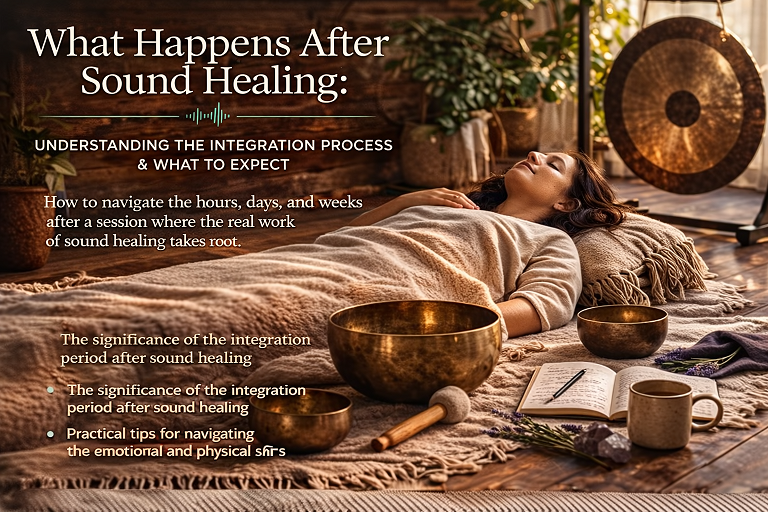
Understanding the Integration Process and What to Expect
You’ve just emerged from a sound healing session. Maybe you were lying on a mat while singing bowls sent ripples of resonance through your chest. Maybe you sat in a room while a gong filled every corner of the air with something vast and low and ancient. Maybe you cried without knowing why. Maybe you fell into a sleep-like state and woke up not quite remembering where you were. Maybe you feel lighter — or heavier — or simply different in a way you don’t yet have words for.
And now the world is asking you to return to it. The car is in the parking lot. The phone has notifications. Dinner needs to happen.
What comes next matters more than most people realize.
The session itself is the opening. What happens in the hours, days, and sometimes weeks that follow is where the real work of sound healing takes root. Understanding this process — the physiology of it, the emotional terrain of it, and how to navigate it with care — is the difference between a pleasant experience and a genuinely transformative one.
The Immediate Aftermath: Why You Feel the Way You Do
In the minutes directly following a sound healing session, many people report a distinct quality of disorientation. Not confusion, exactly — more like the feeling of surfacing from deep water. The edges of things seem softer. Time feels elastic. Ordinary sounds seem either too loud or strangely musical. Thoughts arrive slowly, if at all.
This is not imagination. This is neurological.
During sound healing, the brain has been guided — through entrainment, through resonance, through the sustained presence of specific frequencies — into theta and sometimes delta brainwave states. These are the frequencies of deep meditation, dreaming, and slow-wave sleep. Returning from those states to the sharp, analytical beta frequency of ordinary waking life takes time. The brain doesn’t snap back like a rubber band. It rises through the layers gradually, and during that rising, you exist in a liminal state where the analytical mind has not yet fully reasserted its governance.
This is actually a window of profound opportunity, not a problem to be solved quickly. The theta state is the brain’s most receptive state — the frequency at which new patterns can be written most deeply, at which old ones are most available to be gently released. Rushing back into busyness closes that window prematurely.
In practical terms: move slowly. Drink water. Sit quietly for a few minutes before standing. If you can, avoid your phone for at least twenty minutes after a session. Give the nervous system time to complete what the sound started, rather than interrupting the process before it has finished.
The Physical Body: What Healing Feels Like in Tissue
Sound healing works at the physical level in ways that are more concrete than many people expect. The vibration of instruments like gongs, singing bowls, and tuning forks moves through the body’s water and tissues, reaching depths that conventional touch cannot. This is not metaphor — it is acoustics.
In response, many people experience significant physical sensations in the hours following a session. Some of these are immediately recognizable as pleasant: a deep loosening in the shoulders, the release of tension in the jaw and throat, a warmth in the chest, a quality of physical ease that feels like the body has exhaled something it had been holding for a long time.
Others can be more surprising. Some people feel physically tired — a bone-deep fatigue that is less like exhaustion and more like the feeling after significant physical exercise. This tiredness is not a sign that something went wrong. It is a sign that the body has done real work. Regulation takes energy. Release takes energy. The nervous system, moving from chronic sympathetic activation into genuine parasympathetic rest, is completing a metabolic process, and the body needs rest to consolidate it.
Some people experience mild headaches, particularly if they were significantly dehydrated before the session or if the session involved high-intensity frequencies like large gongs at close range. Hydration before and after sound healing is not optional — it is fundamental. The body conducts vibration through water, and if the cellular environment is water-depleted, both the effectiveness of the session and the recovery afterward are compromised.
Others experience what can only be described as physical memories: areas of the body that were numb during the session suddenly reporting sensation, or old injuries briefly aching before releasing. This is the somatic component of sound healing expressing itself — the body processing stored tension through awareness and movement rather than through suppression.
The Emotional Landscape: What Rises, and Why
This is where the experience of post-session integration becomes most individual, and where the most important guidance lives.
Sound healing does not produce emotions. It creates the conditions in which emotions that were already present — but submerged, managed, or defended against — become available to move. The frequency, the safety of the container, the deeply parasympathetic state of the nervous system during a session, together create something rare in modern life: a moment when the body’s defenses soften enough to allow what is underneath to be felt.
For some people, this means tears during the session that continue gently afterward — a quiet, unhurried grief for something they may not be able to name specifically but recognize as real. For others, it means a sudden and unexpected joy, a lightness, almost a giddiness, that arrives when something heavy has been released and the body is noticing the difference.
For others still, the emotions don’t arrive during the session at all. They arrive the next day, or two days later, in the middle of something ordinary. A conversation that cracks something open. A moment of stillness that suddenly fills. A dream that brings to the surface what the sound had already loosened.
This delayed emotional processing is entirely normal and is one of the most important things to understand about sound healing’s aftermath. The nervous system processes in its own time. What was reached in the session may not be fully felt until the system has had time to create the safety required to let it through.
What this means practically is that the days following a sound healing session deserve gentleness. Not fragility — you do not need to quarantine yourself from ordinary life. But a degree of self-awareness and self-compassion that allows whatever is arising to be received rather than immediately managed or suppressed. If emotion comes, let it move. If quiet comes, rest in it. If confusion comes, allow it without immediately demanding resolution.
Journaling in the days after a session can be remarkably productive — not as a way of analyzing the experience into submission, but as a way of giving form to what is emerging. Dreams may be more vivid. Creative impulses may surface unexpectedly. The inner voice that gets drowned out by noise and busyness may suddenly have things to say.
The Integration Window: The Days That Follow
Sound healers often speak of integration — the process by which the shifts initiated during a session become consolidated into lasting change. Integration is not passive. It is what happens when you consciously tend to the opening that the session created.
In the twenty-four to seventy-two hours following a significant sound healing experience, the nervous system is engaged in a process of re-patterning. The old grooves of chronic tension, habitual reactivity, and automatic stress response have been interrupted. New pathways have been accessed. But patterns that have been in place for years — sometimes decades — do not transform permanently from a single session. They require repetition, reinforcement, and the kind of conscious presence that integration practices provide.
Several things support this window meaningfully. Spending time in nature has a measurable effect on nervous system regulation, reinforcing the parasympathetic shift that the session initiated. Gentle movement — walking, stretching, yoga — helps the body continue processing what was stirred at the somatic level, preventing re-armoring from happening too quickly. Reducing stimulation — less news, less social media, less noise — gives the nervous system the quiet it needs to consolidate rather than immediately re-activating.
Perhaps most importantly: rest. Deep, unhurried, unapologetic rest. The kind of rest that our culture has systematically devalued and that the body, post-session, is specifically requesting. If the session has successfully guided the brain into delta frequencies, the sleep that follows may be among the deepest and most restorative in recent memory. This is not a coincidence — it is the practice working.
When the Experience Is Challenging
It would be dishonest not to address this. For some people, particularly those carrying significant trauma histories or those for whom the session was their first encounter with this depth of somatic experience, the aftermath can feel destabilizing rather than peaceful.
Old memories may surface unexpectedly. Anxiety may temporarily increase before it decreases, as the nervous system processes material that was previously inaccessible. The sense of disorientation that is gently pleasant for some can, for others, feel unsettling.
If this is your experience, the most important thing to know is that it is not a sign that something went wrong. It is often a sign that something went deep. The right response is not to avoid sound healing or to dismiss the experience, but to ensure you have adequate support around the process — a practitioner you trust, a therapist or somatic counselor if appropriate, and a community or relationship in which you feel genuinely safe.
Sound healing is not a replacement for clinical support where clinical support is needed. It is a complement to it — one that can reach places that talk therapy alone sometimes cannot, but one that works best in the presence of a broader container of care.
The Invitation to Keep Going
One session of sound healing is an experience. A practice of sound healing is a different thing entirely — a progressive deepening, session by session, into a relationship with your own nervous system, your own body, and the frequencies that move it toward wholeness. Each session builds on the last. Each integration period lays the ground for what the next session can reach.
What happens after sound healing, ultimately, is up to you. The session opens a door. Integration is the willingness to walk through it.
Support Your Integration with Still Alchemy
If you’ve recently experienced sound healing and are navigating what comes next — or if you’re ready to begin and want guidance from the very first session — Still Alchemy is here for exactly this. Still Alchemy offers not only expert sound healing sessions but also the integration support, nervous system coaching, and personalized guidance that helps what happens in a session become lasting change in your life. Because the session is where the healing begins, not where it ends. Explore Still Alchemy’s offerings today and let the next step be as intentional as the one that brought you here.
You must be logged in to post a comment.