
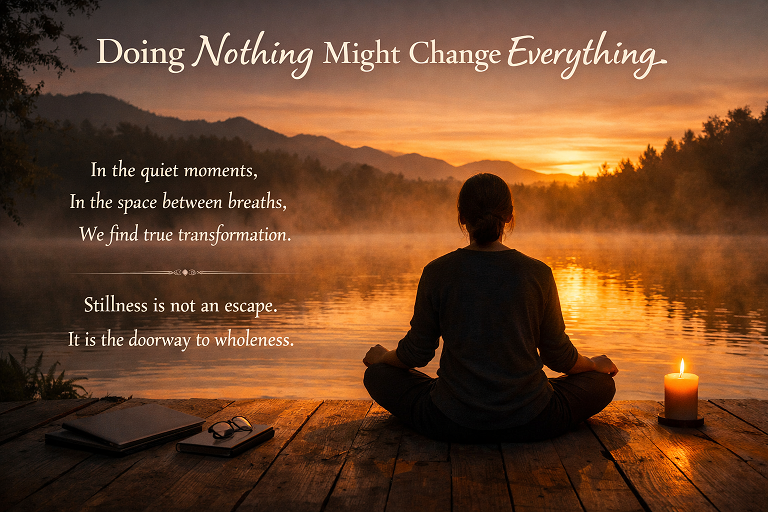
Why Doing Nothing Might Change Everything
There is a quiet revolution happening — not in boardrooms, not on social media feeds, and not in the halls of productivity culture. It is happening in pauses. In the space between breaths. In the moment you put the phone down, close the laptop, and simply sit. Stillness, once dismissed as laziness or wasted time, is now being recognized for what it has always been: one of the most profound tools for healing the human mind, body, and spirit.
In a world addicted to motion, noise, and constant output, choosing stillness is an act of radical self-care. But more than that — it is alchemy. The transformation that happens when we stop doing and simply allow ourselves to be is not passive or inconsequential. It is the invisible work that makes everything else possible.
The Culture of Perpetual Motion — And What It Is Costing Us
Modern society has built an altar to busyness. We celebrate the person who sleeps the least, works the most, and fills every spare moment with stimulation. Rest has been rebranded as recovery — a brief pitstop before the next sprint — rather than what it truly is: a biological necessity and a spiritual birthright.
The consequences of this pace are well-documented and alarming. The American Psychological Association reports that chronic stress contributes to six of the leading causes of death in the United States. The World Health Organization has declared burnout an official occupational phenomenon. More than 50% of adults in Western countries report experiencing persistent fatigue, anxiety, and difficulty concentrating — symptoms that are not simply the price of a full life, but warning signs of a system pushed beyond its limits.
When we deny ourselves stillness, we do not just feel tired. We begin to fragment. Cognitively, we lose the ability to think creatively, make sound decisions, or access deep memory. Emotionally, we become reactive, irritable, and disconnected from the subtler signals of our own inner world. Physiologically, the body stays locked in a state of sympathetic nervous system activation — the fight-or-flight response — flooding itself with cortisol and adrenaline long after any real threat has passed.
Stillness is not the absence of productivity. It is the foundation that makes genuine productivity possible.
What Stillness Actually Is — And Is Not
It is important to distinguish genuine stillness from rest, relaxation, or simple inactivity. You can lie on a couch while your mind races through tomorrow’s to-do list. You can take a bath while replaying a difficult conversation. You can be physically motionless and inwardly in chaos. This is not stillness.
True stillness is a quality of presence. It is the deliberate act of arriving fully in the present moment — not escaping the self, but coming home to it. It involves a softening of the constant inner narration, a loosening of the grip on past regrets and future anxieties, and an opening to what simply is.
In the Eastern contemplative traditions, particularly in Buddhism and Taoism, stillness is understood as the natural state beneath the agitation of the thinking mind. The Taoist concept of wu wei — often translated as “non-doing” — does not mean doing nothing in the literal sense, but rather acting in alignment with the natural flow of things, without force or resistance. Stillness, in this sense, is not emptiness. It is fullness. It is the ground from which everything meaningful grows.
Ayurvedic tradition, one of the world’s oldest systems of medicine, recognizes stillness as a core element of healing. In Ayurveda, disease is understood as a disturbance in one’s natural state of harmony. The practice of creating inner spaciousness — through meditation, breathwork, and sacred pause — is considered not a luxury but an imperative. As Ayurvedic teacher Maya Tiwari has written, the art of pause is our greatest medicine.
The Neuroscience of Stillness: What Happens in Your Brain When You Stop
Science is now confirming what ancient wisdom traditions have long understood. When we enter a state of genuine stillness — whether through meditation, contemplative rest, or simply sitting quietly in nature — our brains undergo measurable, beneficial changes.
The Default Mode Network Comes Alive
For decades, neuroscientists believed that brain activity decreased during rest. Then came the discovery of the Default Mode Network (DMN) — a series of interconnected brain regions that becomes highly active when the mind is not focused on an external task. The DMN is the brain’s internal processing center. It is responsible for self-reflection, perspective-taking, consolidating memories, generating creative connections, and developing a coherent sense of identity.
Research from the National Institutes of Health and numerous university studies has shown that people who engage in regular periods of quiet reflection have stronger DMN connectivity, which correlates with greater emotional intelligence, better decision-making, and higher levels of creative insight. When we never give the mind space to wander inward, we starve this essential network.
Stress Hormones Drop, Healing Hormones Rise
When the body enters genuine rest and stillness, the parasympathetic nervous system — what is often called the “rest and digest” response — takes over from the sympathetic “fight or flight” system. This shift triggers a cascade of healing effects. Cortisol levels drop. Blood pressure lowers. Heart rate variability — a key marker of cardiovascular health — improves. The immune system, suppressed under chronic stress, begins to restore its normal function.
Studies in psychoneuroimmunology have demonstrated that even brief periods of deep stillness can increase natural killer cell activity, reduce inflammatory markers, and accelerate the body’s natural repair processes. The body, given permission to be still, wastes no time using that permission to heal itself.
The Brain Grows in Silence
Neuroscientific research has demonstrated that silence — genuine quiet — promotes neurogenesis, the growth of new neurons, particularly in the hippocampus, the brain’s memory and learning center. A 2013 study by Duke University researcher Imke Kirste found that two hours of silence per day in mice led to the development of new cells in the hippocampus. While human studies are more complex, the evidence strongly suggests that the brain responds to quiet not with dormancy but with regenerative activity.
This is why so many of humanity’s greatest ideas have arrived not during frenetic productivity but in the bath, on a walk, in the moments just before sleep. Archimedes had his eureka moment in the tub. Newton reportedly conceived his theory of gravity while sitting quietly under a tree. Einstein was known to play violin and sail in solitude when working through his most difficult theoretical problems. Stillness is not where thinking stops. It is often where the most important thinking begins.
Stillness and Emotional Healing
Beyond the cognitive and physiological benefits, stillness plays a uniquely powerful role in emotional healing. Trauma, grief, anxiety, and emotional pain do not simply vanish when we stay busy — they go underground. They accumulate in the body, in the nervous system, in the patterns of thought that run beneath conscious awareness. Stillness creates the conditions in which these buried experiences can finally surface, be witnessed, and begin to integrate.
Dr. Michael McGee, a psychiatrist whose work bridges medicine and contemplative practice, describes stillness as a refuge from stormy emotions — like the calm ocean deep below the thrashing surface waves. In stillness, we experience a separation from our compulsive thinking, a moment of genuine respite that promotes what he calls limbic resonance: the capacity for two nervous systems — or a person and their own inner world — to meet in mutual recognition and begin the process of transformation.
Somatic therapy, a growing field that addresses trauma held in the body, draws directly on this principle. The somatic approach recognizes that healing does not happen exclusively through thought or analysis, but through the felt experience of the body in a state of safety and presence. When we are genuinely still, the body begins to release the tension it has stored, the held breath begins to deepen, and the nervous system slowly learns that it is safe to let go.
This is why crying often comes in stillness. This is why grief tends to surface in the quiet. This is why the most honest conversations with ourselves tend to happen not in motion but in pause. Stillness is not avoidance of feeling — it is the condition that makes authentic feeling possible.
The Practice of Stillness: Where Science Meets the Sacred
Across cultures and centuries, humanity has developed an extraordinary range of practices designed to cultivate stillness. What is remarkable is how consistently these practices — developed independently across vastly different traditions — arrive at the same essential truth: that when we quiet the surface noise, we encounter something deeper, more stable, and profoundly healing.
Meditation
Meditation is perhaps the most widely studied and practiced pathway into stillness in the modern world, and the research on its effects is now voluminous. Regular meditation practice has been shown to reduce symptoms of anxiety, depression, PTSD, and chronic pain. It lowers cortisol and inflammatory markers, increases gray matter density in the prefrontal cortex (associated with emotional regulation and decision-making), and measurably reduces the density of the amygdala (the brain’s alarm center) over time.
There is no single correct form of meditation. Mindfulness meditation, Transcendental Meditation, loving-kindness meditation, body scan practices, breath awareness, and contemplative prayer all offer pathways into the same essential state. What matters is not the technique but the quality of presence it cultivates.
Breathwork
The breath is the most immediate bridge between the thinking mind and the body. When we bring conscious attention to the breath, lengthening the exhale and creating space between the inhale and exhale, we directly activate the parasympathetic nervous system. Practices such as pranayama in the yogic tradition, coherent breathing in clinical settings, and box breathing used by military and emergency services personnel all leverage this physiological reality.
The power of breath in stillness is not metaphorical — it is mechanical. The vagus nerve, the longest cranial nerve in the body, runs from the brainstem through the heart, lungs, and digestive system. Slow, deep breathing stimulates the vagus nerve and directly shifts the body into a state of rest and repair.
Nature as a Portal to Stillness
There is growing scientific evidence for what poets and mystics have always known: time spent in nature induces a state of gentle, restorative stillness. Researchers at Stanford University found that walking in nature, compared to walking in an urban environment, significantly reduced activity in the subgenual prefrontal cortex — the area of the brain associated with rumination and self-referential negative thought.
Japanese researchers studying the practice of Shinrin-yoku (forest bathing) have documented remarkable physiological effects: lowered cortisol, reduced blood pressure, increased NK (natural killer) immune cell activity, and improved mood — all from the simple act of spending quiet time among trees. Nature does not demand our performance or our output. In its presence, the body remembers a pace it was never meant to forget.
Silence and Solitude
The relationship between silence, solitude, and healing is ancient. Monastic traditions across Christianity, Buddhism, Hinduism, and Islam have long practiced deliberate silence as a path to spiritual clarity and renewal. Desert fathers and mothers of early Christianity spoke of hesychia — a Greek word meaning stillness, quietude, or inner peace — as the foundation of genuine spiritual life. Sufi traditions speak of khulwa, sacred seclusion, as a prerequisite for the direct experience of the divine.
What these traditions understood — and what modern psychology is confirming — is that the removal of external noise allows access to a deeper internal signal. In silence, we hear what the noise was drowning out.
Stillness and the Body: Restorative Rest as Medicine
Beyond the mind and spirit, stillness exerts a profound healing influence on the physical body. Restorative practices — such as Yoga Nidra (yogic sleep), Restorative Yoga, Non-Sleep Deep Rest (NSDR) protocols developed by neuroscientist Andrew Huberman, and simple periods of deliberate deep rest — activate the body’s repair mechanisms in ways that ordinary activity cannot.
During deep stillness and restorative rest, the body performs essential maintenance work that is impossible during waking activity. The glymphatic system, the brain’s waste-clearance system discovered by researchers in 2013, is dramatically more active during sleep and deep rest than during wakefulness. This system removes metabolic waste products, including amyloid-beta and tau proteins associated with neurodegenerative conditions like Alzheimer’s disease. The body, in stillness, literally cleans itself from the inside.
The lymphatic system — the body’s primary immune and detoxification network — also benefits significantly from stillness paired with deep breathing. Unlike the cardiovascular system, the lymphatic system has no central pump; it relies on movement of the diaphragm and the body’s own rhythmic stillness to circulate lymph fluid and clear waste. Practices that combine gentle stillness with conscious breathing are not passive — they are actively mobilizing the body’s healing infrastructure.
Sleep itself, the ultimate form of stillness, is now understood by sleep researchers as perhaps the single most important behavior for human health. Matthew Walker, neuroscientist and sleep researcher at UC Berkeley, has called sleep the single most effective thing we can do to reset our brain and body health each day. Sleep deprivation has been linked to increased cancer risk, impaired immune function, cardiovascular disease, metabolic disorders, and accelerated cognitive decline. Prioritizing deep, quality sleep is not indulgence — it is medicine.
Still Alchemy: Where Stillness Becomes Transformation
At Still Alchemy, we understand that the journey inward is the most transformative journey a person can take. Our name speaks to this truth. Alchemy, in its oldest sense, is the art of transformation — the transmutation of base metals into gold. But the real alchemy was never about metals. It was always about the human spirit: the recognition that within each of us lies the capacity to transform suffering into wisdom, chaos into clarity, and disconnection into wholeness.
Stillness is the crucible in which that transformation occurs.
We believe, deeply and without reservation, that healing does not always require doing more. Sometimes — often — it requires the courage to stop. To sit with what is. To listen to the signals that the noise has been drowning out. The mind, body, and soul are not broken systems in need of constant fixing. They are intelligent, self-restoring systems that know exactly what to do when given the conditions they need.
Our work at Still Alchemy is about creating those conditions. Through our workshops, offerings, and community, we hold space for the kind of deep, intentional stillness that modern life rarely provides. Whether you are navigating burnout, grief, disconnection, or simply the relentless pace of daily life, we offer pathways back to yourself. Not to a better version of yourself, not to a fixed version — but to the most authentic, rooted, and alive version. The one that was always there, waiting in the stillness.
We invite you to experience stillness not as an absence, but as a presence. Not as emptiness, but as the most fertile ground you have ever stood on. Because when you are truly still, something extraordinary becomes possible: you can finally hear the truth of who you are.
How to Begin: Practical Pathways into Stillness
The most common barrier to stillness is not lack of time — it is discomfort with the unfamiliar. For those conditioned to constant motion, the first moments of stillness can feel restless, even threatening. This is not a sign that something is wrong. It is a sign that the nervous system is accustomed to noise and beginning, tentatively, to remember how to rest. Starting small is not compromise — it is wisdom.
Begin with the breath. Set a timer for five minutes. Sit comfortably, close your eyes, and simply follow the sensation of your breath — the rise and fall of the chest, the temperature of the air at the nostrils. When the mind wanders (and it will), gently bring attention back. This single practice, done consistently, creates measurable changes in nervous system regulation within weeks.
Create a stillness anchor. Choose a consistent time and place for your practice — the same corner of the house, the same chair, the same quiet morning hour. Ritual and repetition reduce the cognitive friction of beginning. Over time, the body begins to drop into stillness simply by arriving at the anchor point.
Spend time in nature without devices. Even twenty minutes in a park, garden, or near water, with the phone left behind, activates the restorative effects of natural stillness. Notice texture, sound, light, and temperature with genuine curiosity rather than rushing through.
Practice deliberate non-doing. Choose one period each day — even ten minutes — in which you do not consume content, engage in productive tasks, or reach for stimulation. Sit, lie down, or move slowly. Do not try to meditate or relax. Simply be present with whatever arises.
Honor the transition spaces. The moments between tasks — waiting for coffee, sitting in a car before going inside, the pause before sleep — are natural invitations to stillness. Instead of filling them with phones and noise, try inhabiting them fully.
Stillness Is Not a Destination — It Is a Return
The healing power of stillness is not a modern discovery, though science is finally articulating its mechanisms in precise and compelling terms. It is a remembering. Across every culture, every century, every tradition of human wisdom, the invitation has been the same: slow down, come back, be here.
You do not need to go anywhere to find stillness. You do not need to clear your schedule, reach a certain state of mind, or earn permission through productivity. Stillness is already within you — beneath the noise, beneath the to-do lists, beneath the stories and the stress. It is the ground you have never truly left.
The alchemical truth is this: you do not need to become something different to heal. You need to become more fully what you already are. And that becoming happens not in the doing, but in the most radical, courageous, quietly transformative act available to any human being.
The act of simply being still.
You must be logged in to post a comment.