
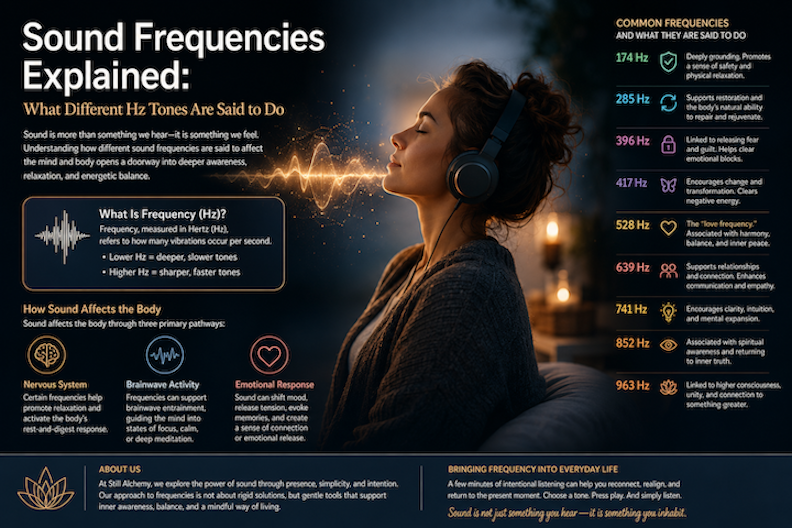
What Different Hz Tones Are Said to Do
Sound is more than something we hear—it is something we feel. Beneath music, ambient noise, and even silence lies a world of vibration that interacts with the body in subtle yet powerful ways. At the core of this experience is frequency, measured in Hertz (Hz). Understanding how different sound frequencies are said to affect the mind and body opens a doorway into deeper awareness, relaxation, and energetic balance.
What Is Frequency (Hz)?
Frequency refers to how many vibrations occur per second. When something vibrates, it creates waves that travel through the air and are interpreted by our ears and brain as sound.
Lower Hz equals deeper, slower tones. These sounds tend to feel grounding, heavy, and calm.
Higher Hz equals sharper, faster tones. These are often perceived as bright, energizing, or even stimulating.
While this may sound purely technical, frequency plays a meaningful role in how we experience the world. Every sound carries a vibrational signature, and that signature can interact with our internal systems in ways that go beyond simple hearing.
https://open.spotify.com/episode/1TvqDLwavj8yxuz1ILcs8K?si=NOXVQbqSSniDfExySQD6Qg
How Sound Affects the Body
Sound influences the body through three primary pathways: the nervous system, brainwave activity, and emotional response.
The nervous system constantly scans the environment for signals of safety or threat. Certain frequencies, particularly slow and rhythmic ones, can encourage the body to shift into a parasympathetic state—often referred to as “rest and digest.” This is why low, steady tones or calming soundscapes can help reduce tension and promote relaxation.
Brainwave activity is another key factor. The brain operates at different frequencies depending on our state of consciousness. For example, slower brainwaves are associated with deep relaxation or meditation, while faster ones relate to alertness and focus. Some sound frequencies are believed to help guide the brain into these states, a process often referred to as entrainment.
Emotional response is perhaps the most immediate effect. Sound can evoke memories, shift mood, and create a sense of connection or release. A single tone or frequency can feel soothing, unsettling, uplifting, or introspective depending on how it resonates with the listener.
Common Frequencies and What They Are Said to Do
While scientific research is still evolving, certain frequencies have gained recognition in sound healing and mindfulness communities for their perceived effects.
174 Hz is often described as a deeply grounding frequency. It is said to promote a sense of safety and physical relaxation, helping to ease tension in the body.
285 Hz is associated with restoration. Many believe it supports the body’s natural ability to repair and rejuvenate, both physically and energetically.
396 Hz is linked to releasing fear and guilt. This frequency is often used in practices aimed at emotional clearing and letting go of limiting patterns.
417 Hz is thought to encourage change and transformation. It is said to help clear negative energy and open space for new beginnings.
528 Hz is one of the most well-known frequencies, often called the “love frequency.” It is associated with harmony, balance, and inner peace, and is commonly used in meditation and sound healing practices.
639 Hz is connected to relationships and connection. It is believed to enhance communication, empathy, and understanding between individuals.
741 Hz is said to support clarity and intuition. This frequency is often used to encourage problem-solving and mental expansion.
852 Hz is associated with spiritual awareness. It is thought to help deepen intuition and reconnect individuals with a sense of inner truth.
963 Hz is sometimes referred to as the frequency of higher consciousness. It is linked to a sense of unity, presence, and connection to something greater than oneself.
It’s important to approach these interpretations with curiosity rather than rigid expectation. The experience of sound is deeply personal, and what resonates with one person may feel different to another.
The Subtle Power of Listening
In a fast-moving world filled with constant stimulation, intentional listening becomes a powerful practice. When you slow down and tune into sound, you begin to notice how it affects your breathing, your thoughts, and your physical state.
Lower frequencies can feel like an anchor, drawing attention inward and encouraging stillness. Higher frequencies can create a sense of lightness or movement, gently lifting awareness.
This interplay between tones mirrors the natural rhythms of life—expansion and contraction, activity and rest. By engaging with sound consciously, you create space to rebalance these rhythms within yourself.
Sound as a Tool for Awareness
Sound frequencies are not a cure or a quick fix. Instead, they act as a tool—something that can support awareness and intentional living. Whether used in meditation, relaxation, or quiet reflection, frequencies can help guide attention back to the present moment.
You may notice subtle shifts: a slower breath, a quieter mind, or a sense of calm that wasn’t there before. These shifts are not imposed by the sound itself but arise through your interaction with it.
This is where sound becomes more than a passive experience. It becomes a practice.
About Us and Our Approach to Sound
At Still Alchemy, the exploration of sound is rooted in presence, simplicity, and intention. Rather than presenting frequencies as rigid solutions, we see them as invitations—gentle tools that support inner awareness and balance.
Our approach is grounded in the belief that transformation does not come from forcing change but from creating space for it. Sound, in its purest form, offers that space. It allows you to slow down, listen deeply, and reconnect with your natural rhythm.
We focus on creating experiences that feel calm, uncluttered, and aligned with a mindful way of living. Whether you are new to sound exploration or have an established practice, the goal is the same: to provide a quiet foundation where you can explore what resonates with you.
In this way, sound becomes part of a broader journey—one that includes stillness, reflection, and intentional presence.
Bringing Frequency Into Everyday Life
You don’t need a complex setup to begin exploring sound frequencies. Even a few minutes of focused listening can make a difference.
Start by choosing a tone or frequency that feels comfortable. Sit or lie down in a quiet space and allow the sound to play in the background. Notice how your body responds. There is no need to analyze or interpret—simply observe.
Over time, you may begin to recognize patterns in how different frequencies affect you. Some may help you unwind after a long day, while others may support focus or creativity.
The key is consistency and openness. Rather than searching for a specific outcome, allow the experience to unfold naturally.
Sound frequencies offer a unique way to engage with the body and mind. While the science continues to evolve, the experiential aspect remains accessible to anyone willing to listen.
By understanding what frequency is and how it interacts with the nervous system, brainwaves, and emotions, you gain a new perspective on something that is always present in your life.
In the end, sound is not just something you hear—it is something you inhabit. And within that space, there is an opportunity to find stillness, clarity, and connection.
You must be logged in to post a comment.